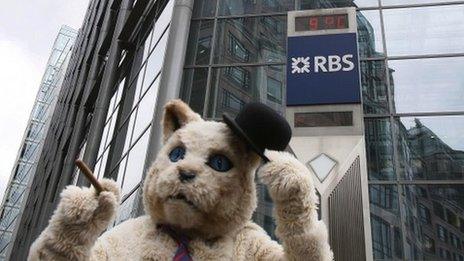
Taxpayer-owned bank RBS says it lost £2bn in 2011, almost double what it lost the previous year.
Despite that, boss Stephen Hester says he's making progress in sorting out the bank's problems.
Hester recently turned down a £1m bonus after he came under pressure from politicians and the media.
Bonuses for other RBS bankers have been halved, but basic pay has risen.
It's argued that, in the long run, decent salaries are needed to get the right people so that taxpayers get their money back.
Find out how the once successful bank got into trouble.
2007 - Financial crisis begins
Confidence in the financial world starts to drop because of worries over American home owners not being able to afford their 'sub prime' mortgages.

Northern Rock was one of the first UK banks to get into trouble
Many banks have investments that are connected to the loans and so the worries spread and lending between banks dries up.
Big global investments banks like UBS and Citigroup report multi-billion dollar losses.
In September, the effects hit home in the UK when Northern Rock customers panic and withdraw £1bn after hearing the government has had to help the bank.
April 2008
As the uncertainty continues, 100% mortgages disappear from the market and the Bank of England reveals a £50bn plan to help struggling UK banks.
RBS says the financial crisis means it's had to write off £5.9bn of bad debt and that it's going to try to support itself by selling £12bn of new shares.
Interest in the shares isn't high enough though and things don't look good for the bank.
October 2008 - Government bail out
After a dramatic few months, which sees Bradford & Bingley nationalised and the collapse of US bank Lehman Brothers, the government sets up a rescue package for UK banks.
Days later, there's even more dramatic news for RBS, Lloyds TSB and HBOS.
The government decides to pump billions of pounds of taxpayers' money into the banks and effectively nationalise them.
The banks are just too important to risk going under because they hold so much of the public's money.
In return, the government gets a big say in how the banks are run.
RBS boss Fred Goodwin quits and is replaced by current boss, Stephen Hester.
February 2009 - Massive loss and pension controversy
RBS announces the biggest ever loss for any UK company - £24.1bn in 2008. Most of it is blamed on the bank's decision to buy a Dutch bank, ABN Amro.

Fred Goodwin was criticised for the size of his pension pot
The government gives RBS another £13bn of taxpayers' money to help it recover from the massive loss.
The final bailout ends up being £45.5bn, meaning taxpayers now own 82% of the bank.
Former chief executive Fred Goodwin also comes under fire for his pension pot after it comes out that he's getting £650,000 a year, despite only being 50.
Current chancellor George Osbourne calls the amount "obscene" and the story is all over the media.
Goodwin apologises for leading the bank to failure and says he "could not be more sorry" for what happened.
June 2009
Fred Goodwin gives in to pressure and agrees to reduce his pension to £342,500.
RBS today
The bank, which also owns insurers Direct Line and Churchill, is still trying to recover from the disaster of 2008.

Current RBS boss Stephen Hester turned down his £1m bonus
Thirty-thousand employees have been laid off, 22,000 of them in the UK.
In January 2012, Fred Goodwin was also stripped of his knighthood for bringing the bank to the verge of collapse.
Current chief executive Stephen Hester also turned down his £1m bonus last month, with politicians like Labour leader Ed Miliband saying he had "done the right thing".
The government says it's keeping a close watch on the bank and that its bonuses are a third of what they were in 2009.
RBS also says it's helping the average person on the street.
It claims more than 40p in every £1 it lends goes to UK small and medium-sized businesses, and that it gives out 4,000 business loans each week.
- Published30 January 2012

- Published27 January 2012