
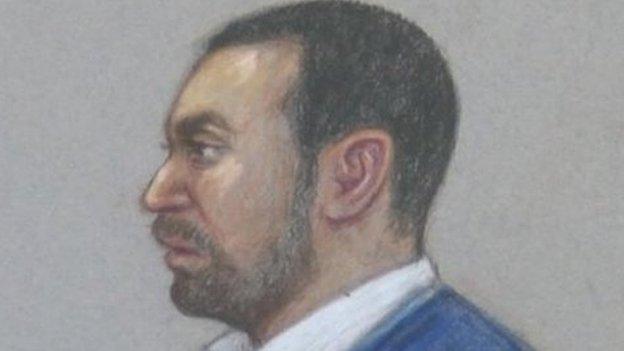
Mr Sardar claimed he went to Iraq to help Sunni Muslims fight off Shia militants
The jury in the trial of a British man accused of working on a series of bombs that killed a US soldier in Iraq has retired to consider its verdicts.
Anis Abid Sardar, 38, of north London, denies murder, conspiracy to murder and conspiracy to cause explosions.
US soldier Sgt Randy Johnson, 34, was killed in an explosion near Baghdad in 2007, Woolwich Crown Court heard.
Mr Sardar has admitted his fingerprints were on two bombs but denies knowing they would be used against US patrols.
The court heard allegations that Mr Sardar was part of a group that made a series of bombs that were buried under the roads west of Baghdad in September 2007.
However, Mr Sardar, from Wembley, insisted he was helping local Iraqis defend themselves from sectarian attacks.

Sergeant Randy Johnson died after taking the full blast of a homemade bomb
During the trial, he said he went to Iraq from Damascus, where he was living and studying Arabic, to help Sunni Muslims fight off Shia militants.
But prosecutors said the size, design and roadside location of the devices meant that they could only have been intended to destroy armoured US patrols.
Although the offences took place in Iraq and the victim was American, the prosecution was brought in Britain as Mr Sardar is a British citizen.
The court heard that Sgt Johnson, of the 2nd Cavalry Regiment, was killed when the Stryker eight-wheel armoured vehicle he was travelling in hit a homemade bomb on 27 September 2007.
Other US soldiers were seriously injured by the blast and also in a fire-fight while dealing with another device.
The bomb that killed Sgt Johnson had been "part of a sequence" that was a "joint effort" by Mr Sardar and others, it was alleged.
- Published29 April 2015
- Published28 April 2015

