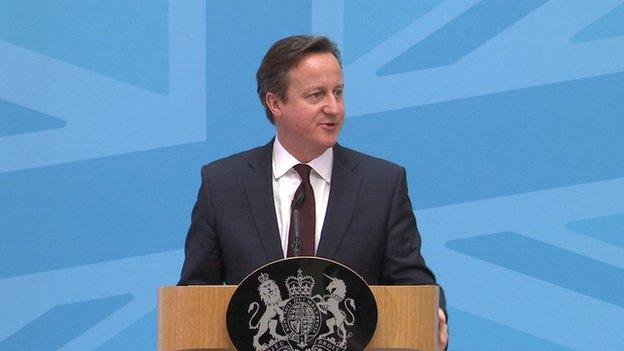
Ministers have been urged by migration advisors to act with caution before raising minimum salary levels for skilled migrants from outside the EU.
The Migration Advisory Committee (MAC) also says there is very little evidence of skilled workers in the UK having their wages undercut by such migrants.
David Cameron previously said it was "frankly too easy" for some businesses to bring in workers from overseas.
The current minimum salary for those skilled migrants is £20,800.
Some occupations set higher minimum salary levels under the so-called Tier 2 visa route.
There is an annual cap of 20,700 on the number of people allowed into Britain from outside the European Economic Area (EEA) under this method, with the cap having been reached for the first time in June.
The committee had been asked by the government to investigate the impact of raising minimum salary levels as part of its aim to reduce migration.
But the committee said this could lead to "bottlenecks constraining the growth of individual firms", adding this is "to some extent already the case".
'Be cautious'
It says restricting Tier 2 migrants could "limit UK productivity growth", with the introduction of a higher salary threshold causing "serious problems in particular sectors, including the education and health sectors".
Firms questioned by researchers for the report also warned that making it more difficult for migrants to take up jobs in the UK could force them to expand their businesses overseas.
The report said: "Overall, a number of firms said that increases in thresholds could lead to increases in the cost of their services, prevent expansion of business and thus possibly cause certain business areas to grow elsewhere in the world at the expense of the UK."
Committee chairman Professor Sir David Metcalf said: "We urge the government to be cautious in making any significant changes to the salary thresholds at this stage because they should not be considered in isolation."
As part of its findings, the committee also said that skilled non-EEA workers were often paid the same or more than those already in the UK.
It concluded that if there was any undercutting of wages, this was isolated rather than widespread.
The cap does not include intra-company transfers, with some 36,500 highly-skilled employees of large companies switching their place of work to the UK last year.
A Home Office spokesman said: "We thank the Migration Advisory Committee for their report. We will consider its findings and respond in due course."
The committee is to publish a wider review at the end of the year.
- Published11 August 2015

- Published21 July 2015
- Published17 July 2015
- Published10 June 2015
- Published21 May 2015