
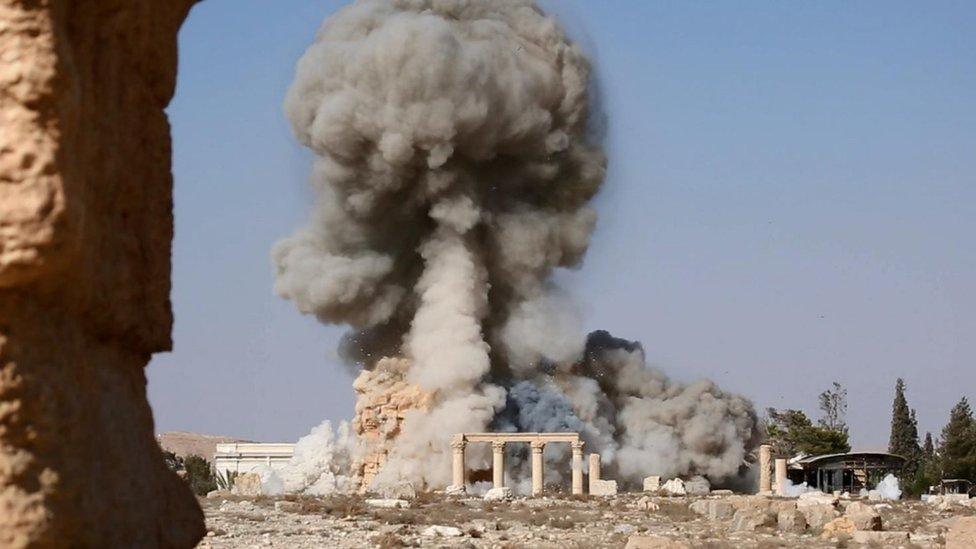
The temple of Baal Shamin was blown up by IS in August
Cameras capable of taking 3D images are to be given out across the Middle East in a bid to preserve ancient sites from destruction by Islamic State group.
Thousands of residents will be asked to capture images as part of a project by Oxford and Harvard archaeologists.
The photos should allow academics to use 3D printers to build replicas of damaged buildings and artefacts.
There is said to be a renewed urgency after a temple in the Syrian city of Palmyra was destroyed by IS militants.
The project by the Institute for Digital Archaeology intends to distribute up to 5,000 cameras in conflict zones across the world and capture about one million images of at-risk objects by the end of 2016.
"This is a race against time," its executive director Roger Michel told BBC Radio 4's Today Programme. "We've changed our timetable in recognition of the places being destroyed."
Although countless ordinary photos have been taken of the sites, the 3D technology the team is using will allow them to potentially recreate the objects as well.
The team has designed a cheap 3D camera that will allow inexperienced users to capture high-quality images that will be uploaded automatically to an online database.

The 5,000 year-old citadel in Aleppo has since been damaged by explosions.

Samarra, north of Baghdad, is listed as a Unesco World Heritage site.

Crac des Chevaliers is one of the Crusader castles in Syria

Erbil in Iraqi Kurdistan is not under IS control
Mr Michel said: "Digital archaeology, in my view, is the best hope that we have for preserving the architecture, the art history, of these sites."
"Distribution is the biggest challenge," he added.
Officials will also work with Unesco to give the cameras out to locals, who are keen to lend a hand in the project.
Mr Michel said: "All around the Middle East, they feel so strongly about their local identity and history that they're willing to help."
- Published25 August 2015
- Published30 June 2015

- Published28 March 2018
- Published21 June 2015


