Michal Fallon and Ash Carter will want to present a united front
Britain's Defence Secretary Michael Fallon and US Defense Secretary Ash Carter are in London, displaying a united front.
First in working together in the fight against the extremists known as Islamic State (IS), but also in condemning Russia's recent military intervention in Syria.
The US and UK shoulder to shoulder and all that. Though the truth is - not quite.
Britain is so far only bombing IS in Iraq.
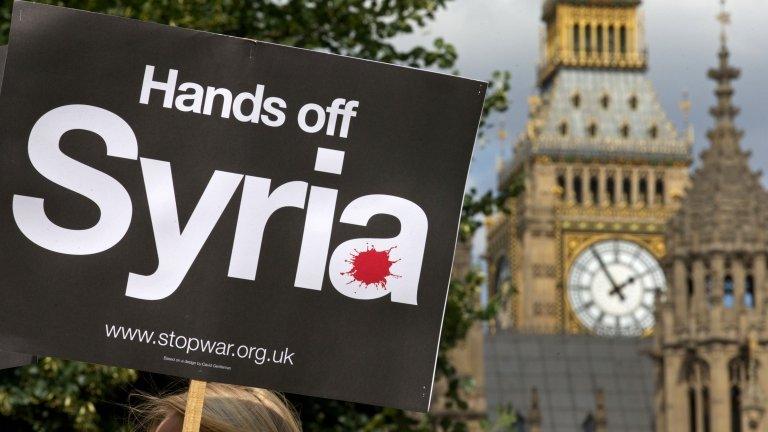
Mr Fallon says the government is working hard to build a consensus to get parliamentary support for airstrikes in Syria.
He argues there is a moral case to do more, saying: "Is it really right that to keep the streets of Britain safe we should be relying on Australian, French or American aircraft?"
France has recently taken the decision to bomb targets, external in Syria (though so far it's happened just once).
France has more manned aircraft carrying out strike missions against IS than the UK - 12 versus eight.
It has also sent an aircraft carrier, external to help in the fight and the Charles de Gaulle may soon be returning to the region.
UK impact
So would British military intervention in Syria really make a difference?
Sir Nick Harvey, a defence minister in the last coalition government, thinks the answer is no - beyond a bit of symbolism.

The UK has 10 Reaper unmanned aircraft in the Middle East campaign
He said: "We are making a modest contribution in Iraq, so I suppose it would be more of the same."
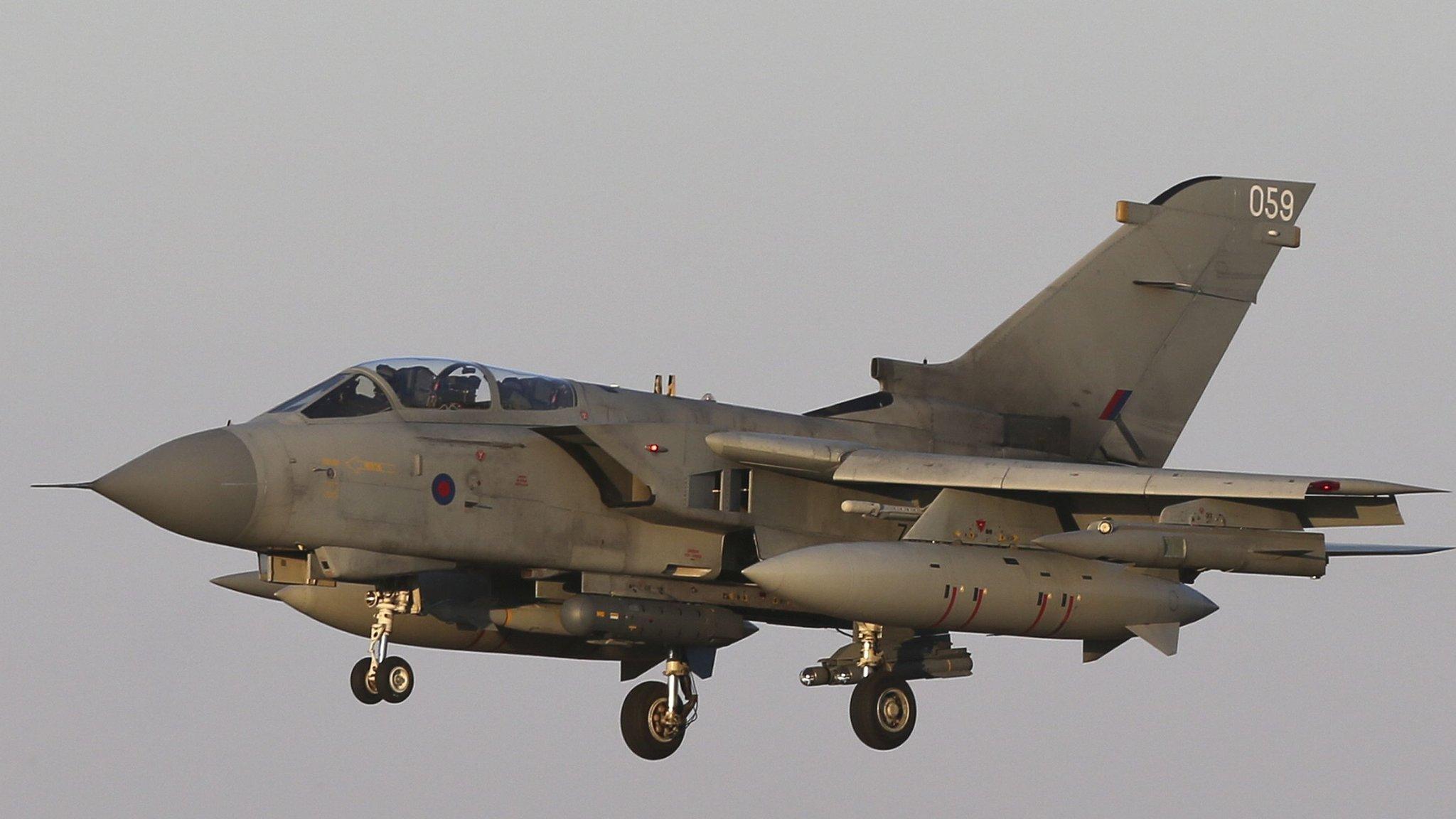
Defence cuts mean the RAF can offer little more in terms of strike capability beyond the eight Tornado jets and 10 Reaper unmanned aircraft already taking part in the air campaign.
The RAF would be hard pressed to offer more - it only has three Tornado squadrons with a total of about 40 front-line jets.
The Tornado is the only British aircraft capable of dropping both Brimstone missiles and Paveway IV bombs, as well as carrying the large raptor pods for aerial reconnaissance.
Over the past year, during "Operation Inherent Resolve", external, US Central Command (Centcom) estimates the US-led coalition has killed 10-15,000 IS fighters.
In contrast the Ministry of Defence estimates that RAF strikes have killed around 330.
A recent Royal United Services Institute (RUSI) report, entitled "Inherently Unresolved", external estimates that Britain has spent around £13m on munitions over the past year.
In contrast, it says, the US has spent more than $1.5bn (£981m).

Brimstone missiles can hit fast-moving targets
The gulf in numbers tells the story that Britain's contribution is limited, though Mr Fallon is keen to point out the RAF is also providing 30% of the total coalition surveillance and reconnaissance effort over both Syria and Iraq.
The RUSI report concludes that "...while the RAF's contribution will not make much difference to the coalition's strike capability (in Syria), the availability of the Tornado would provide a greater range of options".
Though the Tornado is an ageing warplane, it does carry the Brimstone Missile, which can hit fast-moving targets.
But it is hardly a game changer and the US has similar, if slightly less capable weapons.
Exit strategy
This all suggests David Cameron might have a tough sell persuading MPs to back military action in Syria - just as he did in 2013 (though that vote was about authorising military action against the Assad regime rather than IS).
Sir Nick Harvey says ministers will have to answer a number of questions that so far have not properly been addressed: What's the purpose? What does success look like? And what's the exit strategy?
He asks: "Do we really want to take on the 30 or maybe 50 years liability of sorting Syria?" adding that it would be an even greater liability than Iraq or Afghanistan.
The lesson from Libya is you can't win wars entirely from the air.
David Cameron: "It is clear to me that the British parliament...does not want to see British military action"
And there is no desire to put British boots on the ground.
Russia's intervention will make it an even tougher sell.
Even before its airstrikes, and salvo of cruise missiles, there were already added dangers to flying over Syria.
President Assad's forces have long had sophisticated, Russian-made, air defences.
Now he is being backed by Russian warplanes, warships and troops.
They do not have the same objectives as the US-led coalition.

Vladimir Putin appears to have a clear military strategy in Syria
Russian planes appear to have deliberately crossed, external into Turkish airspace.
And Russia is bombing "moderate" Syrian rebels backed by the US.
There is little common ground and lots of potential for something serious to go wrong.
Moscow also appears to have a much clearer military strategy.
It wants to help Assad and views all groups fighting him as "terrorists".
In contrast Julian Lewis, chairman of the House of Commons Defence Select Committee, says Britain (and the coalition) still needs a "credible strategy leading to a realistic objective".
Who’s fighting whom in Syria? Explained in 90 seconds
He concludes that at present "we have neither".
Mr Lewis argues the West cannot achieve both goals of destroying IS and forcing President Assad out of office simultaneously.
The Conservative MP believes the priority must be to defeat IS and if necessary to work with others to achieve that objective.
Dent to prestige
Michael Fallon would dearly love to stand beside the US Defence Secretary and assure him that Britain too will soon be taking part in airstrikes over Syria.
But he can't and that will hurt.
Britain likes to think of itself as America's closest ally.
Not being part of the coalition hitting IS targets in Syria will rankle with ministers.
Not just for moral and military reasons, but ones of prestige too.
Will America view Britain's reticence as another example of "strategic shrinkage"?
- Published8 October 2015
- Published3 October 2015
- Published17 September 2015
- Published8 September 2015
- Published30 August 2013