
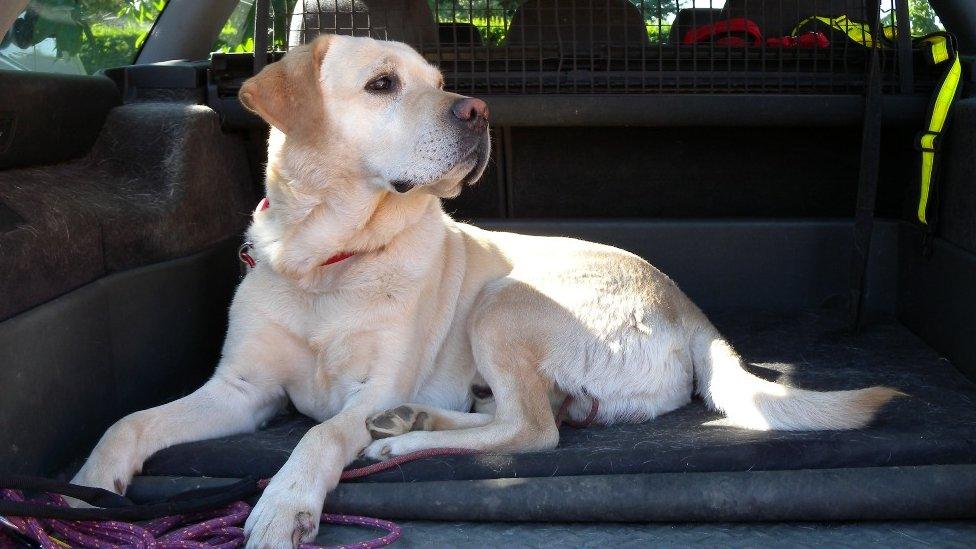
Tui, aged 18 months, is being trained to sniff out the scent of the "elusive" harvest mouse
A dog is being trained to sniff out mice as part of a wildlife conservation project based in Northamptonshire.
Retriever Tui is being trained by a researcher at Moulton College studying the decline of harvest mice in the UK.
They are difficult to find and count, so it is hoped Tui will be able to identify them when presented with samples gathered from potential nest sites, pin-pointing breeding hotspots.
The training is funded by the People's Trust for Endangered Species (PTES).
The organisation believes the harvest mouse population has declined over the past 40 years because of changes to farming practices.
'Mouse pods'
However, it said: "To date there have been no reliable studies to quantify this change, and it is unclear as to exactly how many are currently left in the UK."
Tui is being trained by Emily Howard-Williams to sniff out this "elusive yet iconic species".

It is not known how many harvest mice are left in the UK but they are believed to be in decline
The dog will use its sensitive scent receptors to identify the rodents once her training is complete in about two months' time.
Miss Howard-Williams has devised a series of "mouse pods" - plastic bottles containing samples of mouse food - that might or might not have the scent (urine and faeces) of harvest mice.
About 12 pods are used to test whether Tui is accurately identifying the scent.

Once trained, Tui will carry out her work in a laboratory
When Tui recognises the scent is from a harvest mouse she will sit down, alerting her owner to the fact.
"She is very good at it, but the next stage is to train her to discriminate between harvest mice and other rodents - they have different scents," Miss Howard-Williams said.


How could Tui help?
Researchers will place food containers in numerous sites where harvest mice might be nesting
These will be collected complete with any faeces or urine left inside
In a lab, Tui should be able to identify which feeders have been used by harvest mice
This will help conservationists locate breeding hotspots
Miss Howard-Williams said this method will be much faster than humans trying to locate harvest mice nests which are "difficult to find"
Miss Howard-Williams, who refers to Tui as "our resident harvest mouse detector dog", said she hoped the PTES funding would "enable us to determine whether using sniffer dogs is the best approach in tracking these creatures".

The harvest mouse
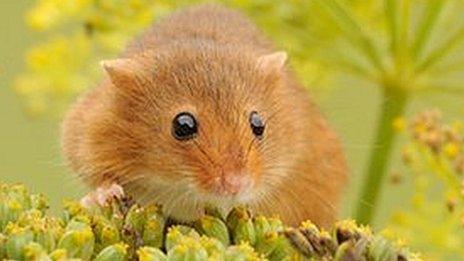
The harvest mouse is Britain's smallest rodent
In Britain, it is found from Yorkshire southwards and parts of Wales
It is also found in most of Europe, east Russia, Japan, South China and North Korea
A harvest mouse measures between 5cm and 8cm and weigh 5-11g
It is most active at dusk and goes underground during the winter
Females give birth to up to three litters a year
Source: BBC Nature
- Published23 August 2015

- Published22 January 2015
- Published28 September 2013
- Published18 August 2011

- Published17 October 2010


