
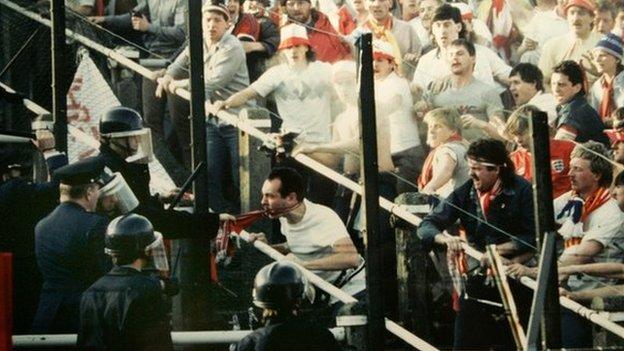
Juventus fans were trying to escape a surge by Liverpool when a concrete wall collapsed
It was the highlight of the 1985 football season - the European Cup final between Liverpool and Juventus.
And for almost 40 schoolboys and staff at a Northern Ireland school, it was a day they would never forget.
But 29 May 1985 remains vivid in their minds three decades on for all the wrong reasons.
On the 30th anniversary of the Heysel stadium disaster, two teachers who led a Belfast Boys' Model school trip to the match recall the horror that unfolded before them and how close they came to being caught up in the catastrophe.
Thirty-nine people died, including Patrick Radcliffe who was originally from Bangor in County Down, and 600 others were injured when a wall collapsed on supporters of Italian club Juventus as they tried to escape a surge by Liverpool fans.
Excitement
The young footballers of Belfast Boys' Model were playing in a tournament in Amsterdam in the Netherlands on the week of the European Cup final, being held in the Belgian capital Brussels.
Many of the boys were Liverpool supporters, and when the agent they were travelling with got 38 tickets for the game the excitement began to build, as teacher Dennis Russell remembers.

Fourteen Liverpool supporters were jailed for three years for their part in causing the disaster
"We couldn't believe our luck, it was as simple as that," he says.
"Everybody was jealous, a lot of other kids wanted to go once they heard we were going to the European Cup final.
"Little did we know that 30 years on we'd still be thinking about it."
The group were in sector Z of the stadium. It was here that the concrete retaining wall collapsed as supporters were climbing over to escape the crush.
Andy McMorran, another teacher on the trip, recalls the group's narrow escape as the horrific events unfolded.
"We were very, very lucky," he says.
"One of the other teachers with us said he thought something was going to happen and he was right.
"He got us out a gate at the bottom [of sector Z] to go to another section.

The game was played despite the disaster in order to prevent further disorder, Juventus winning 1-0
"We had a view of it. The wall [the supporters] were being crushed on all of a sudden collapsed. I likened it to sand running out of a sand-dune - it was horrific.
"That's the one thing that stuck with me - I was watching bodies. It was colours from a distance, but it was actually bodies."
Ambush
The game was played despite the disaster in order to prevent further disorder, Juventus winning 1-0.
But the danger was not over yet. Tension, anger and hatred between the supporters of both sides had been festering during the game and police feared more trouble would erupt after the final whistle.
"The Italian fans had got to know what had happened, and the concept was that they were going to ambush any Liverpool supporters that they could find," Mr Russell says.
"Terrifying's not the word. I don't know what kicks in, but I suppose it's called self-preservation."
As the group reached their coach, the driver told them to pull the curtains and get on the floor.
The driver refused to stop until they reached the border.
The teachers contacted their loved ones and passed on the pupils' telephone numbers for them to call and reassure their parents that the boys were safe.

Thirty-nine people were killed and 600 were injured in the Heysel disaster
It was the only the next day when the group was back in Amsterdam that they realised how lucky they had been to escape unhurt.
As they read newspaper coverage of the disaster, one stark image from the previous night hit home.
Fear
"When we were getting in [to the stadium] at the very start there was a block of Italians that weren't letting anybody past as we came up the steps.
"We got to a point where there was a guy who was beating a drum, he actually let us through.
"Unfortunately, one of the photographs of one of the bodies was the guy with the drum. That hit the kids - they realised he had let us through."
For Dennis Russell, the memory of Heysel still remains crystal-clear.
"I saw an article two weeks ago and thought: 'Thirty years ago... good Lord.'
"The boys were brilliant. It was a matter of looking after everybody, and they were tremendous on that night.
"But some of those children I now meet on a regular basis still talk about the fear."
- Published29 May 2015
- Published29 May 2015


