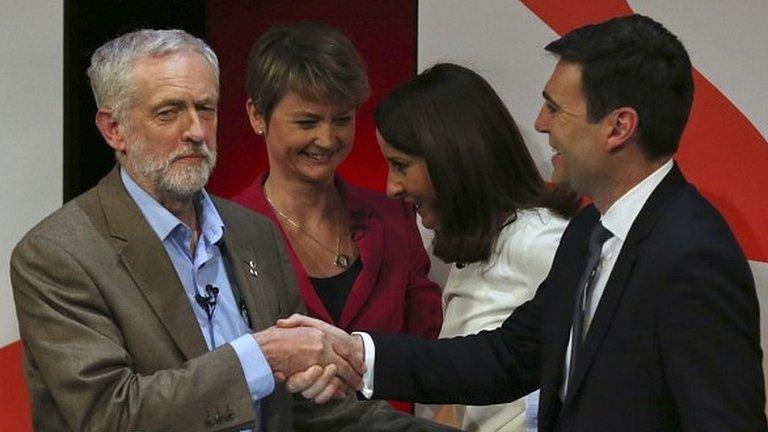
Labour should ignore "difficult headlines" and consider extra taxes to cover the rising cost of social care, leadership contender Andy Burnham says.
Mr Burnham says his goal of a National Health and Care service will require a "difficult financial change".
But in a speech in Leeds, he said Labour should not fear a backlash from the "Tory press".
He would create a commission which would also consider replacing tuition fees with a graduate tax system.
Mr Burnham's speech, marking the 70th anniversary of the Attlee Labour government, is seen as an effort to get back on the front foot in the leadership contest.
It also included a scathing criticism of the current Labour Party, which he accused of being "frightened of its own shadow".
The Leigh MP said the anniversary of the 1945 government should be "cause for joyous celebration, but I mark it with a sad realisation that the modern Labour Party could not have created the NHS".

Analysis by Ross Hawkins, BBC political correspondent

'Now Gordon wants £20,000 when you die'.
That was the charge on a Conservative poster before the 2010 election, external.
Conservatives accused Labour's then Health Secretary Andy Burnham and leader Gordon Brown of plotting a "death tax".
Twice Mr Burnham has argued the policy should feature in Labour manifestos. Twice he has lost the argument.
Now, he is taking his case direct to the party.
He clearly thinks voters would prefer to know the state will take an extra chunk of their inheritance, than risk losing the lot to care costs.
If the idea becomes Labour policy in 2020 the Conservatives will be sure to update their poster.
Councils have predicted a £4.3bn shortfall in care budgets - including residential care and help at home - by the end of the decade.
To plug the gap, Mr Burnham said social care should be treated like the NHS, "where everybody is asked to make a contribution according to their means".
This would mean that "everybody then has the peace of mind of knowing that all their care needs, and those of their family, are covered", he said.
He added: "And yes, let me be clear: I would have to persuade people of a difficult financial change to bring this about.
"And this is where the modern Labour Party has always backed off, fearing difficult headlines in the Tory press."
His new commission will consider ways to cover the costs of social care, including a new "care levy".
It will also look at ways to get people onto the housing ladder.
Labour leadership contest

Liz Kendall has been urged to back Andy Burnham or Yvette Cooper to defeat Jeremy Corbyn
Who are the candidates? Andy Burnham, Yvette Cooper, Jeremy Corbyn, Liz Kendall
Dates: Ballot papers will be sent out on 14 August; voting can take place by post or online. They must be returned by 10 September. The result is on 12 September
Who can vote? All party members, registered supporters and affiliated supporters - including those joining via a union
What is the voting system? The Alternative Vote system is being used so voters are asked to rank candidates in order of preference
How does it work? If no candidate gets 50% of all votes cast, the candidate in fourth place is eliminated. Their second preference votes are then redistributed among the remaining three. If there is still no winner, the third place candidate is eliminated with their second preferences (or third in the case of votes transferred from the fourth place candidates) redistributed. It is then a head-to-head between the last two candidates
Mr Burnham's speech comes as a poll , externalfor the Independent suggests Labour is less electable now than under Ed Miliband.
And an analysis by the Labour-affiliated Fabian Society says the party must broaden its appeal to Conservative voters, rather than "lurching to the left", if it is to have "any chance" of winning in 2020.
Mr Miliband led Labour to its worst electoral defeat since the 1980s, with the party down to 232 seats at the 2015 general election.

Senior Labour figures have warned that a Mr Corbyn victory would render Labour unelectable
His subsequent resignation sparked the leadership contest, with Mr Burnham, Yvette Cooper, Jeremy Corbyn and Liz Kendall all in the running to succeed him.
The popularity of left-winger Mr Corbyn, who only got into the contest because some MPs nominated him to "broaden the debate", has sparked a row within Labour.
Some MPs have called for the contest to be restarted after "hard left" campaigners and Conservative supporters were reported to be backing him, and with one poll suggesting he was on course to win.
- Published26 July 2015

- Published12 September 2015