
Twenty-one years have gone by.
To listen to some of the Labour debate today you might think that Tony Blair's election as leader in 1994 was the beginning of the end.
As it happened it was not the end, but the prelude to the longest continuous period in power that Labour has ever had - 13 years.
But Blair's first conference speech as leader in 1994 is now an emblem of history that much of his party wants to erase.
There is no modern equivalent for a cultural shift in a party that has been so quick and so complete.
Call yourself a Blairite these days and you might as well be a leper in the Middle Ages ringing a bell to advertise your shame and sending people running from the streets.
Why?
The simple answer would be Iraq. And there's no doubt that across the Labour Party there's an overwhelming view that the Iraq invasion was a mistake and, most of them think, a deceitful one.
Then there's the money attached to the Blair name, which has been damaging too.
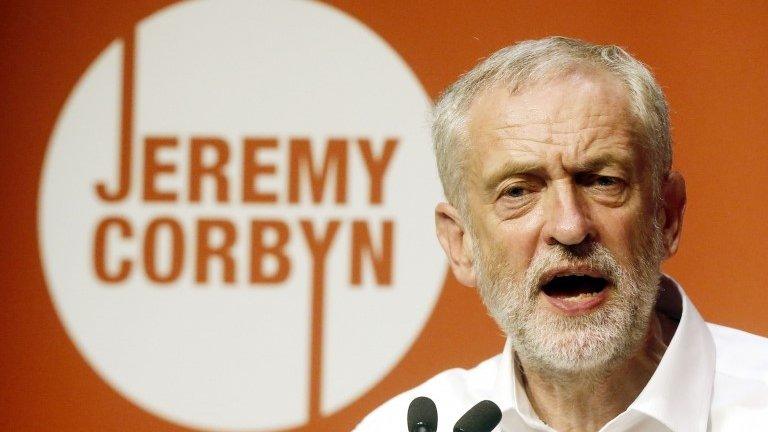
But even taken together, these factors are not enough to explain the surge of support for Jeremy Corbyn - a candidate who, remember, had to round up proxies to get enough nominations from MPs to get into the leadership contest in the first place.

Jeremy Corbyn just made it into the leadership contest but now is the frontrunner
It's as if he's been able to drill a well and tap into a hidden sea - waters that slake the thirst for a different taste and make a cleansing drink.
Brown - frustrated by events
Gordon Brown's three years in power were so dominated by the financial crisis that they became an exercise in recovery.
His hope that he could be a Brownite rather than a Blairite - how antique the labels already feel - was frustrated by events.

Brown was trapped by his record as chancellor
And how could he make a break and still retain his record as Blair's "Iron Chancellor"? He was trapped.
A rejuvenated left now speaks of light-touch regulation of the banks under Brown with a horror like their opposition to the war.
And it left Brown's successor in opposition, Ed Miliband, unable to write a convincing script of his own, because that too involved dealing with a past of which he was a part.
Miliband's misery
Miliband was caught between a desire to mark a break with the Blair years and his need to defend most of the decisions he'd been part of in the Brown government.
He was ensnared by the past.
And when the votes were counted in May it was obvious that he'd failed to escape its coils.

Ed Miliband stood down as Labour leader on 8 May
The dread question that Labour candidates heard again and again in the street was a simple one: what do you stand for?
They could all recite a list of reforms that were popular when they'd been made, and they could sing a hymn to the NHS, but it wasn't enough. Something had been lost.
It was a far cry from the scene in the Commons in 2007 when Tony Blair was cheered to the rafters as he left the chamber for the last time as prime minister.
But nothing that Labour has done since has persuaded voters that the vacuum has been filled.
What next?
Look at Scotland, with a Labour Party on its knees, sunk on its own hallowed ground.
Look at England outside the northern cities and London - a party in ramshackle retreat.
It's as if the argument in 2007 - what next? - is only now being joined.
When people speak of the years in power we hear from Alastair Campbell or Peter Mandelson, sometimes from Tony Blair himself.
It always feeds, among many Labour members, an evermore urgent feeling that they want to cast off their modern history, like an old snakeskin.
When you reach that point, it's nearly impossible for candidates with a past to cleanse themselves.
They may be right to say it's unfair, but they also know it's true. They haven't yet written the next chapter in their own words and they're paying the price.

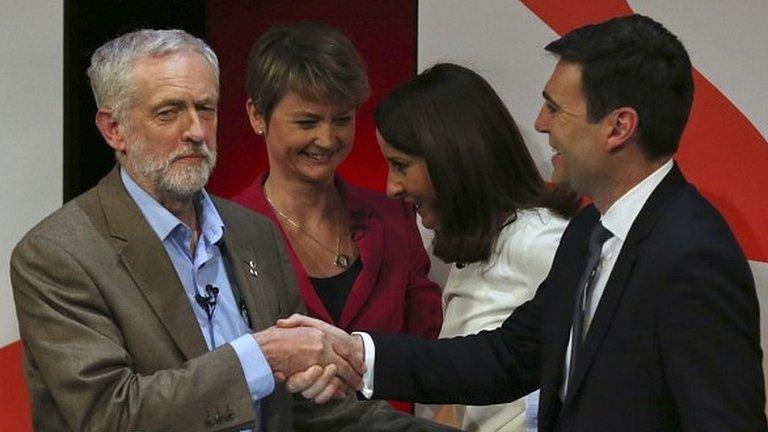
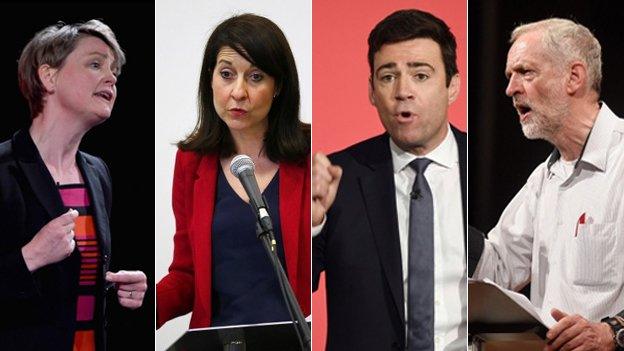
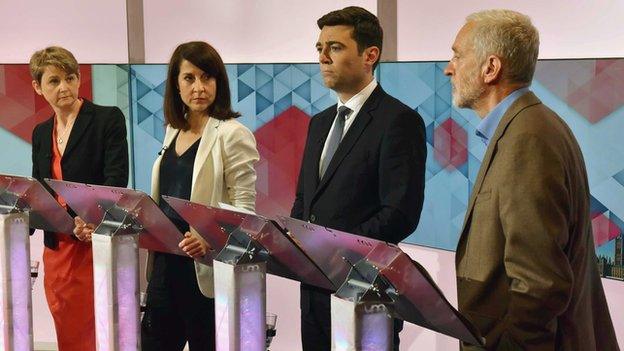
The leadership candidates (from l-r): Yvette Cooper, Liz Kendall, Andy Burnham, Jeremy Corbyn
Introspection
Whether or not Jeremy Corbyn wins, the message of this leadership election seems likely to be the same: that it's a moment for change. But that's only the start.
If this has been an argument postponed, it makes it all the harder and probably all the more drawn out.
Whether you think - as so many of the old hands do - that a Corbyn win would usher in a festival of factionalism and struggle; or whether you think that there is a new left alternative waiting to be devised that could be popular; the prospect is maybe the same: a time of introspection and a struggle for supremacy in the party.
The odd thing maybe is that it's taken eight years since Tony Blair's departure for that battle to begin in earnest.
None of us knows what the leadership result will bring about, whoever wins it.
The important point is that Labour people - Corbynista or Blairite - don't know either.
And that's why it's a contest awash with heavy tides of excitement and despair.

Labour leadership contest
Who are the candidates? Andy Burnham, Yvette Cooper, Jeremy Corbyn, Liz Kendall
Dates: Ballot papers were sent out on 14 August; voting can take place by post or online. They must be returned by 10 September. The result is announced on 12 September
Who can vote? All party members, registered supporters and affiliated supporters - including those joining via a union. More than 160,000 people signed up to vote as supporters, full members or union affiliates in the final days before the registration deadline, bringing the total size of the electorate to 610,000
What is the voting system? The Alternative Vote system is being used, with voters asked to rank candidates in order of preference
How does it work? If no candidate wins outright with more than 50% of first preferences, whoever is in fourth place drops out and the second preferences of their backers are reallocated to the other candidates. If there is still no winner the third placed candidate is then eliminated with their second preferences similarly reallocated. The candidate who has accumulated the most votes through the different rounds then wins.

Listen to James Naughtie on the Today programme on Saturday, between 07:00 and 09:00.
- Published12 September 2015
- Published21 August 2015
- Published20 August 2015
- Published10 August 2015
- Published21 August 2015
- Published11 August 2015


