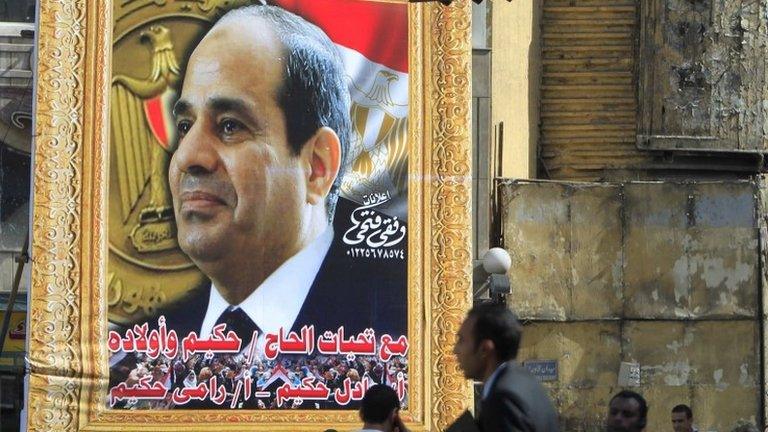
Prime Minister David Cameron met with President Sisi this week
The visit of Egyptian President Abdel Fatah al-Sisi to London marks a significant warming of relations with a country whose recent political turbulence has strained its relationship with many Western states - Britain included.
Egypt, of course, matters - not so much because of history (it was, after all, a British protectorate for many years), but because of economic interests and the country's strategic and political role in the wider Arab world.
At a time when the region is in chaos, Egypt, for all its problems, appears a bulwark of stability.
Egypt was the largest and most significant player in the abortive political transformation known as the Arab spring.
A military-backed authoritarian system was replaced by a short-lived democratic experiment in which the Islamists of the Muslim Brotherhood held sway.
President Abdul Fattah al-Sisi: "I think we have seen very positive change"
It was Gen (as he then was) Abdel Fatah al-Sisi's troops who ended Islamist rule.
And despite removing his uniform, now that he is president, and mouthing general commitments to a democratic transition in the future, the Egyptian political system is now much as it was, albeit with a more dynamic and forceful ex-military man at the helm.
Improving relations
Western policy has struggled to keep up; adjusting in the first instance to Muslim Brotherhood rule, albeit with little enthusiasm.
But the overthrow of Egypt's democratic experiment initially prompted a chill in relations.

Egypt's long-time leader Hosni Mubarak was deposed after mass protests in 2011
It is this chill that President Sisi's visit is intended to temper.
Relations have been steadily improving for some months.
Britain remains the largest foreign investor in Egypt, and the Foreign Secretary Philip Hammond led a British delegation to an investment conference at Sharm el-Sheikh last March.
The Defence Secretary, Michael Fallon, represented the UK at the opening of the new expanded Suez Canal.
BP is one of the largest foreign investors in Egypt, with plans to invest more than £8bn in the next five years, helping to unlock Egypt's own gas deposits in the West Nile Delta.
This business-focused policy has alarmed human rights groups and campaigners.

The British ambassador in Cairo spoke out against the detention of Al Jazeera journalists
The British ambassador in Cairo did, though, speak out against the treatment of three Al Jazeera journalists accused by the authorities of supporting terrorism.
This did not go down well with the Egyptian government.
But as the current visit of the Egyptian president illustrates, it is also shared strategic interests that have fostered a resumption of closer relations between London and Cairo.
Egypt is seen both as a victim of terrorism but also as a key regional bulwark in the fight against so-called Islamic State (IS) and other forms of Islamist instability.
It is, after all, engaged in a difficult counter-terrorism campaign in the Sinai.
And the immediate tensions over the suspension of British flights to Sharm el-Sheikh notwithstanding, if it was indeed an IS bomb that brought down the Russian Airbus, then Egypt's position in the wider coalition against terrorism will only be reinforced.

Abdul Fattah al-Sisi:
born in Cairo on 19 November 1954
graduated from Egypt's Military Academy in 1977
trained at the UK Joint Services Command and Staff College in 1992, and received a master's degree at the US Army War College in 2006
early career spent in the army, rising to chief-of-staff of the 2nd Mechanised Infantry Division and then chief-of-staff of the Northern Military Zone
appointed deputy director, then director of Military Intelligence and Reconnaissance
becomes youngest member of the Supreme Council of the Armed Forces, after uprising topples Hosni Mubarak in February 2011
appointed commander-in-chief of the armed forces and defence minister in August 2012, by President Mohammed Morsi
overthrows Mr Morsi, suspends the constitution and installs an interim government in July 2013, following mass opposition protests
promoted to field marshal in January 2014
announces run for presidency
won more than 93% of the vote in the subsequent election, which was boycotted by most political parties and the Muslim Brotherhood
- Published26 March 2014