
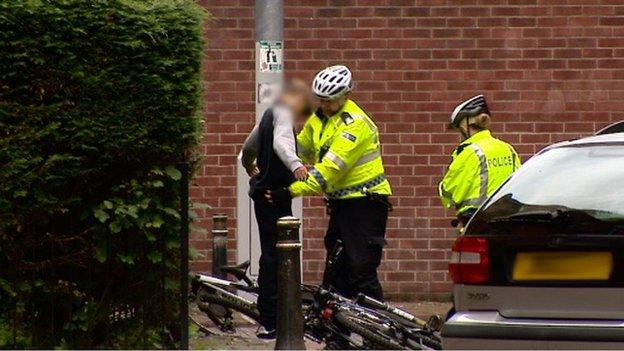
The commission says stop-and-search should only be carried out where there is "a clear legal basis"
The Scottish Human Rights Commission has taken its concerns about controversial police stop-and-search practices to the United Nations.
In a report to the UN, it underlined the need for stop-and-search to take place within the legal framework set out by the International Covenant on Civil and Political Rights.
It initially raised the issue with the UN Human Rights Committee a year ago.
The body has previously called for an end to non-statutory stop-and-search, external.
The latest move follows public concern about the widespread use of stop-and-search measures in Scotland.
Police have considered scrapping consensual searches, having already committed to ceasing the practice with under-12s.
'No tangible change'
Scottish Human Rights Commission (SHRC) chairman Prof Alan Miller said: "Stop-and-search has its place as a means of ensuring public safety.
"However, it should only be carried out where there is a clear legal basis for interfering with someone's basic right to privacy.
"We should all be free to go about our daily business unless the police have reasonable suspicion that we are doing something illegal.
"Police Scotland has repeatedly failed to take appropriate steps to address the concerns that the commission and others have raised.
"A review announced in February promised progress but, in reality, has not led to any tangible change."
He added: "Unlawful stop and search continues to take place on Scotland's streets. This must stop."
SHRC said it looked forward to a forthcoming report by the Stop and Search Advisory Group, established by the Scottish government, and would respond accordingly.
In a statement, external, Police Scotland Assistant Chief Constable Wayne Mawson said: "Police Scotland recognises it is important to strike a balance between protecting the public and the rights of the individual and we are committed to complying with requirements of the Human Rights Act and our Code of Ethics and Police Values, where stop and search must be carried out with integrity, fairness and respect."
'Areas for improvement'
ACC Mawson said "some areas for improvement" had been identified following an extensive review of stop-and-search by Police Scotland and independent reviews by bodies such as the Scottish Police Authority and Her Majesty's Inspectorate of Constabulary in Scotland.
He added: "As part of our Stop and Search Improvement Plan, Police Scotland has made significant steps toward delivering these improvements with the publication of new operational guidance and a new enhanced national database.
"We remain committed to driving ongoing improvements around stop and search through continuing to work with others.

"In addition, we will ensure that any recommendations from the independent Stop and Search Advisory Group are considered and acted upon when reported in the future."
A Scottish government spokeswoman said: "Stop-and-search can be a valuable tool in combating crime and has led to the seizures of dangerous weapons, drugs and stolen goods.
"However, clearly it is important to get the balance right between protecting the public and the rights of the individual.
"The new independent advisory group, chaired by John Scott QC, is considering the longer-term policy around the use of consensual stop and search and will make their recommendations by August 2015."
'Damning'
Scottish Liberal Democrat justice spokeswoman Alison McInnes said: "The Human Rights Commission has closely advised the national force during its attempts to reform this controversial tactic.
"It is therefore all the more damning that this independent public body has concluded that there has not been 'any tangible change' and chosen to refer the matter to the United Nations for a second time.
"I am pleased that the commission is among the ever-growing number of independent experts to endorse the abolition of so-called consensual stop and search.
"I hope to achieve this in September through my amendments to the Criminal Justice Bill."
Elaine Murray, Scottish Labour's spokeswoman for community safety and legal affairs, said: "This is an incredible intervention from the Scottish Human Rights Commission.
"It has been clear that concerns around stop and search have been building for some time.
"Police officers in Scotland put their personal safety and their lives on the line to keep people safe but it has become clear that there is a target-driven culture in the organisation that many Scots will find alarming, and that officers may find detrimental to their jobs."
Research published last month suggested people in Scotland were four times more likely to be stopped and searched by police than elsewhere in Britain.
The University of Edinburgh's Scottish Centre for Crime and Justice Research found that seven out of the 10 UK police divisions most likely to use stop and search were in Scotland.
This was despite a 38% drop in the practice since the merger of forces to form Police Scotland in 2013.
- Published19 June 2015
- Published5 February 2015
