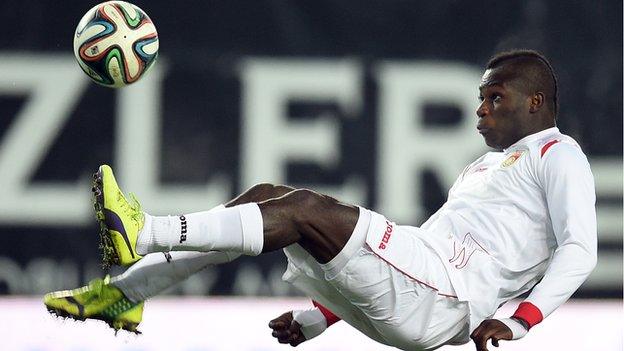
United Glasgow took part in the 2013 Anti-Racism World Cup in Belfast
Meet the team hoping to break down the barriers of racism, discrimination and financial exclusion in Scottish football.
United Glasgow FC (UGFC) was set up as a means to get players from all walks of life involved in football, when it otherwise wouldn't be possible due to lack of insurance, money or equipment.
Since its inception in 2011, the organisation has grown to include 11, seven, and five-a-side men's teams, and a more recently formed women's team. All of them compete in various amateur leagues in Scotland.
Collectively, the teams boast around 120 players between them. Over the years, UGFC have seen players join from 55 different countries including Sudan, Somalia and Syria.
Committee member Alan White founded the team to combat the isolation often felt by refugees as they arrived in Glasgow without family, friends, or a strong grasp on the language.

He said: "We felt that we could provide access to sport as a means of helping to improve their physical and mental health.
"We soon realised that some of the barriers to sport, particularly around finances, hit young working-class people in Glasgow too and we decided that a team like ours could be a place for people to access sport without the prohibitive cost and also meet people that they might not otherwise have met."
The training sessions are made financially accessible - priced at £1 per player - ensuring that those who may be on welfare or are struggling with money are still able to attend.
'Like brothers'
Training sessions are heavily subsidised by the coaches and volunteers, and the team otherwise relies on donations and external funding to keep them going, although money is only accepted from groups who share the same politics and practices as them.
Earlier this year it was announced that net migration figures in the UK are at an all time high.
As an escalated number of people are seeking asylum in Scotland, football teams like UGFC are an essential part of the integration of refugees into their new society, says team member Christopher Priestly, who moved to Glasgow seven years ago from Newcastle-upon-Tyne.

He said: "It's all well and good to be settled in the way that the government can allow - to put a roof over your head and provide for you - but I think the community needs to take some responsibility to immerse people in our lives, and to give them that depth and variety that they need to be happy.
"I think there's quite a lot of isolation among migrants of all kinds, who can't necessarily settle in an area and don't have a network of family and friends around them.
"UFGC is a great opportunity for people to really branch out and have something to look forward to.
"No one's coming here just because they love football - people really buy into the project and really want to do great things."
Another player, Ahmed, who has been with the team for eight months after fleeing Sudan a year ago, said United Glasgow were "like brothers" to him.
'Surreal and proud'
UFGC's relations with similar teams across Europe have seen them travel further afield than their training ground of Glasgow's Firhill complex, including the 2013 Anti-Racism World Cup in Belfast.
Mr White feels pride seeing them compete abroad.
"Seeing how much players have enjoyed trips to Ireland, England, Germany and Italy has been fantastic," he said.
"Of course, in general, acknowledging the fact that we have international connections is always a surreal and proud moment."
Equality network Football Against Racism in Europe (Fare) have recently added UGFC to their European database of grassroots organisations which are helping to provide access to football for refugees and asylum seekers.
They are currently Fare's only recognised team in Scotland, and one of eight in the UK.
Fare executive director Piara Powar said: "Football and sport in general has an opportunity to show social and cultural leadership in demonstrating how refugees can be made welcome in new surroundings, to help them build a new life.
"We have been heartened by brilliant initiatives such as United Glasgow that have begun to spring up across Europe - they make a welcome change from some of the other things we see in football.
"It's also why we have set up a database of grassroots football activities for refugees and are developing a methodology that can be used by clubs of whatever size in working with new communities."
Mr White added: "It doesn't work for everyone and in every town or city, but we genuinely believe that football can help bring people together in a place where there are new arrivals; be that Glasgow, Leeds, Hamburg, Rome or anywhere else."
- Published19 February 2015
- Published21 July 2015