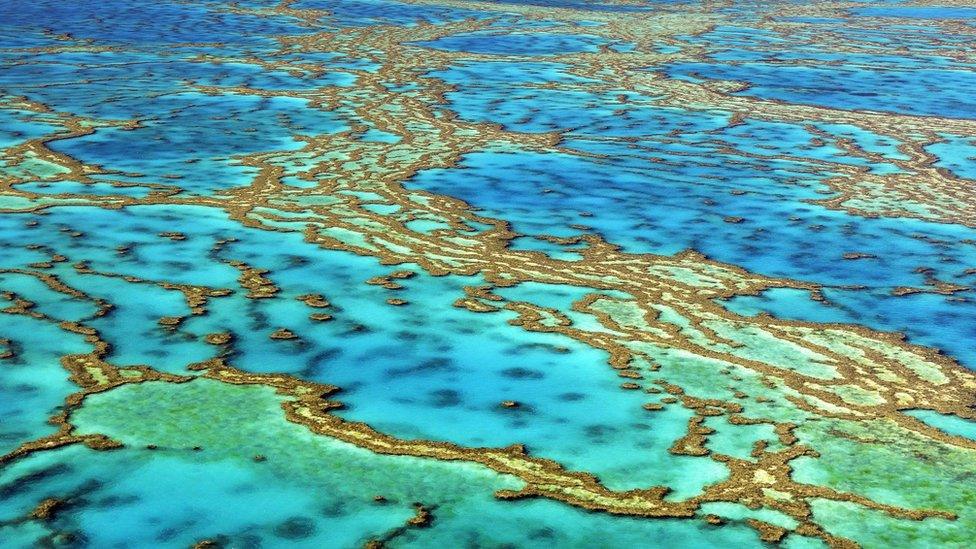
Great Barrier Reef showing small signs of recovery says new report
- Published

The world's most famous coral reef is showing signs of recovery.
The Great Barrier Reef is a huge area of living coral off the coast of Australia, which is home to thousands of species of plants and animals.
It's so big it can even be seen from space, and is protected with World Heritage status for its "enormous scientific and intrinsic importance".
A new report by The Australian Institute of Marine Sciences (AIMS) has shown that coral is starting to grow back in some areas of the reef despite being hit by mass coral-bleaching, cyclones and crown-of-thorns starfish.
Of the 86 reefs they looked at, more than two thirds showed a small increase in the amount of coral growing back.
What did the report show?

One of the scientists uses the "manta tow" to assess the coral
AIMS has been monitoring the Great Barrier Reef for the last 35 years, and each year it releases a special report of its findings.
For this year's report head researcher Dr Mike Emslie and his team monitored the reef between September 2019 and June 2020.
They used something called a "manta tow" to asses the reef, where a marine scientist is pulled along underwater above a section of the reef for two minutes.
Some of the coral reefs on the planet today began growing more than 50 million years ago!
The results showed that the coral reefs in the Northern region had stayed stable, and that in the central region the amount of hard coral had increased from around 12% in 2019 to 14% in 2020.
The southern region showed the greatest increase in coral recovery at 24%, and is known to bounce back better than the other areas.
The scientists have warned that although the report does share some positive news, the outlook for the reef overall is not great.
"The reef is resilient, but this resilience has limits," said Dr Mike Emslie.
What problems can affect coral reefs?

Coral bleaching leaves coral extremely vulnerable
Things like marine heatwaves caused by climate change can create mass coral-bleaching events, which can wipe out whole areas of reef.
As well as this, extreme weather such as cyclones, and an increase in the destructive 'crown of thorns' starfish can also cause damage to the reefs.
One of the main things scientists have been worried about, is how often these negative events have been happening to the reefs,
"The Reef is taking repeated hits from coral bleaching, cyclones and crown-of-thorns outbreaks. While we have seen the Great Barrier Reef's ability to begin recovery from these pressures, the frequency and intensity of disturbances means less time for full recovery to take place," Dr Emslie said.
Bleaching happens when sea temperatures get too high or low, causing the algae that live in coral to get 'stressed out' and leave.
This then turns the coral white and, with its main source of food gone, it is left very vulnerable.
The researchers said that most of the survey work for this year's report was done before a mass-bleaching event took place last summer,
This is the third mass coral bleaching event in the last five years, as a result of several weeks of continued "unprecedented" high sea temperatures.
"The slight increases in coral cover across much of the Great Barrier Reef this past year are encouraging, but the full effect of the mass bleaching on coral mortality will not be known for several months," Dr Emslie said.
In 2018 the Australian government pledged £275 million to help protect the Great Barrier Reef.
- Published30 November 2019

- Published20 January 2020
- Published29 April 2018