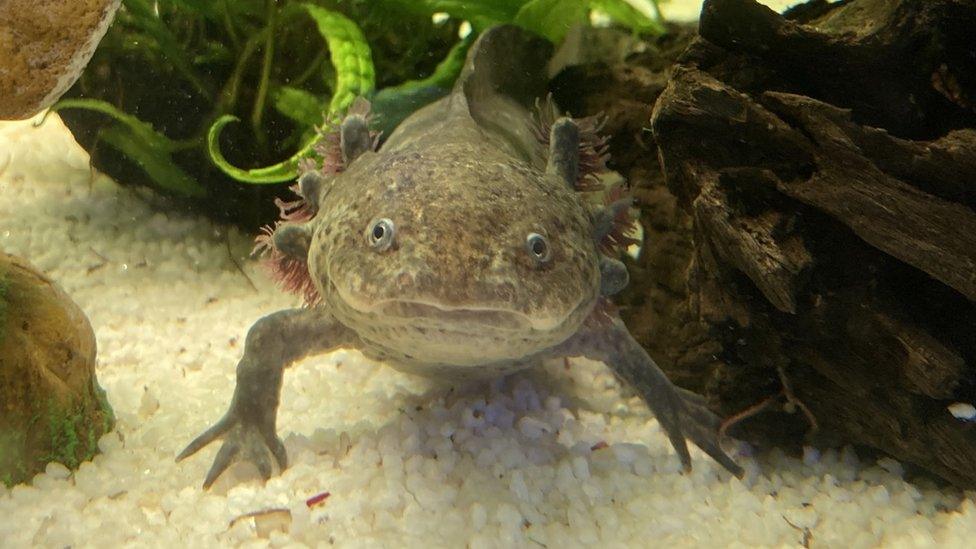
Scientists asking people to 'adopt' an axolotl
- Published

Scientists in Mexico are worried about the future of the axolotl, and are asking for people to help by "adopting" one of the creatures.
This doesn't mean they would take one home, but rather donate money to help pay for efforts to save the endangered animal.
It's being run by Mexico's National Autonomous University (UNAM), and last year raised more 450,000 pesos, which is more than £20,000
The money was used to help clean up some of canals where the animals can be found, and help with a program to raise axolotls in a safe environment.
The sponsorship programme allows people to give different amounts of money, to help with different aspects of their care.
For 600 pesos (just under £28) someone can"virtually adopt" one of the animals for a month, which involves getting live updates on your axolotl's health.

There are 18 species of axolotl
Smaller donations can help pay for their food, and larger donations include a visit to the protected area where UNAM is raising axolotls.
Scientists at the university have been working for years to protect axolotls, and hope this year's program will raise even more money than last year.
The axolotl is an unusual kind of fish-like salamander. Most salamanders can live on both land and in water, but axolotls live their whole lives in the water.
They have a long body, short legs, a long tail, and smooth, slimy skin, and feathery-looking gills.
Axolotls are famous for their ability to heal themselves, which means if an axolotl loses a leg, or even part of its heart, brain, or lungs, it can regrow them.
Scientists are very interested to understand more about how they do this, and think the information could even help solve some medical problems for humans.
Almost all 18 species of axolotl in Mexico remain critically endangered.
An international study found less than a thousand of the Mexican axolotl - the best-known of the species - left in the wild.

The Mexican axolotl - the best-known - is only found naturally in Lake Xochimilco near Mexico City.
Why have axolotls become endangered?
Scientists used to find thousands of axolotls, but the number of axolotls in Xochimilco has dropped by almost 100% in less than 20 years - and it's thought there are now only finding dozens left.
Although it is referred to as a lake, Xochimilco is rather a collection of canals and smaller bodies of water which have become polluted.
Another problem axolotls have had to deal with are other invasive fish in the lake like rainbow trout, which are eating the axolotl's food, and even their eggs.
Researchers say deadly amphibian fungus, called chrytid fungus, has also been killing large numbers of axolotls.

Rainbow trout are one of the reasons axolotl have been struggling, with both species competing for the same food sources
The money raised through the sponsorship programme will be used to support the scientists' work, and help restore the axolotl's natural home in the canals of Xochimilco.
The scientists hope if they can raise enough, they can also carry out a count to find out exactly many axolotls are left in the wild to help them know the best ways to protecting the species for the future.
Alejandro Calzada is an ecologist surveying less well-known species of axolotl for the government's environment department.
He said his teams "lack big monitoring of all the streams in Mexico City," and certainly don't have the resources to carry out research on the animals in other parts of the country.
Without data on the number and distribution of different axolotl species in Mexico, it is hard for experts to know how long the creatures have left, and where to prioritize what resources are available.
- Published10 February 2022
- Published28 July 2021