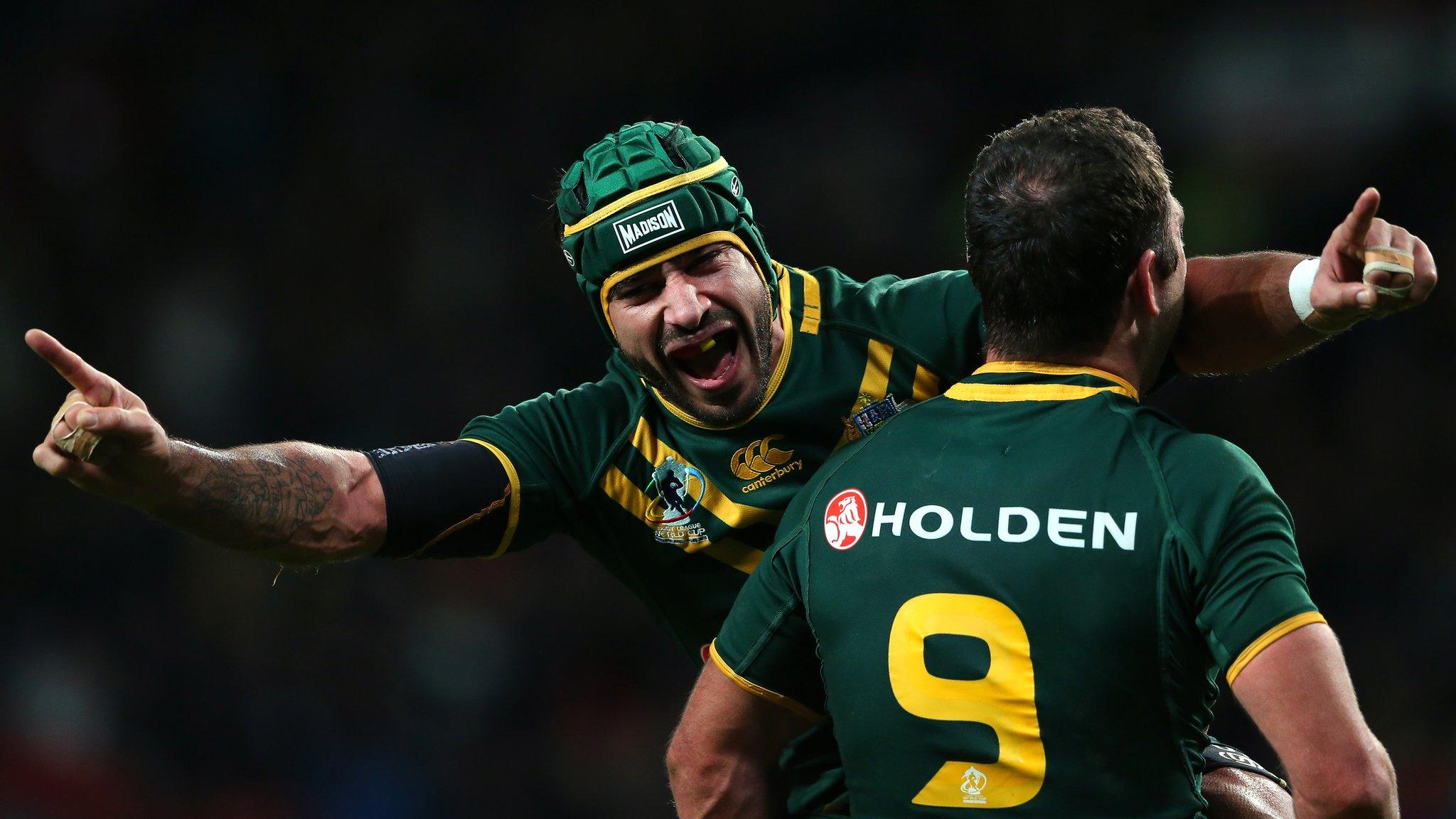
Scotland RL chairman Keith Hogg said Brough was extremely apologetic for his actions after he was thrown out of the Scotland squad
Rugby League World Cup on the BBC |
|---|
Venues: Australia, New Zealand and Papua New Guinea |
Dates: 27 October to 2 December |
Coverage: Watch live coverage and highlights on BBC TV, Connected TV, online & the BBC Sport app and listen to live commentary on BBC Radio 5 live and sports extra. |
So here we go again - let's give rugby league a good kicking because it's full of grubs and lowlife.
And if you need the proof, just check out the Rugby League World Cup headlines.
England full-back Zak Hardaker was banned for using cocaine before the tournament began, Scotland captain Danny Brough and two of his team-mates were kicked out of the tournament for being too drunk to get on a plane. That came the week after two Italian players brawled in a bar over a woman, while Frenchman Eloi Pelisier was sent home for missing a curfew.
On Wednesday England winger Jermaine McGillvary was cleared of a charge of biting an opponent during his team's win over Lebanon.
There were 850,000 clicks last Sunday on the BBC website story about Brough and his team-mates, while social media has been busy poring over the bad news stories. And for some, those stories are defining the tournament.
But while the actions of Brough and several others are inexcusable that's certainly not the whole truth about this World Cup and the game of rugby league in general. And if you're solely focusing on the worst of it, then you're in danger of missing the best of it.
Rugby league generally is populated by some fantastic characters.
They play one of the most physically demanding sports around - the average tackle involves 40-miles-per-hour collisions that have been described as akin to a car crash.
For 80 minutes most players will do their level best to pretend they are not hurt, when the fact is that most are carrying an injury of one sort or another from the first match of every season.
The stars of England, Scotland, Wales and Ireland started this season in February and will only finish in late November. If the England players reach the final, you can make that early December.
When this World Cup is over it'll be a couple of weeks off before they are off to army camps and the like for the kind of brutal pre-season training that would reduce most of us to sobbing misery.
The best of them get paid a decent wedge, but that's only the best of them. And even the top players will earn nothing like the income of other similar status sports stars.
The average wage in Super League is around £50,000 a year - though one top-level coach admitted to me that he has coached Grand Final winning teams in the Super League in which he had players on less than the minimum wage.
So even though some players earn a very decent income, it's broadly part of a pay scale that keeps most of them on a similar footing to the majority who pay to watch them. The connection between the man and woman on the terrace and the player on the field remains strong.
And there certainly aren't any big bucks to be earned by a lot of players at this World Cup. The Ireland players, we've been told by an insider, are receiving £30 a day expenses. In Australia that probably buys you breakfast.

Italy full-back Tedesco is a big star in the NRL and his alleged brawl made headlines - but most of them have been about positive aspects of the tournament
The Scotland and Wales players will be on similar subsistence.
For a lot of them, being here is actually costing them money. Sadly, I know of two players who have chosen not to come and play for their countries because they simply can't afford to. There are probably more.
So although there are no excuses when an airline judges that players are too drunk to board a flight - and Brough himself has apparently been extremely apologetic about his actions - let's at least place their actions in perspective.
It is behaviour that does the game no favours, but it's not the actions of pampered sportsmen abusing their privileged status.
Let's not paint the sport as a refuge for vagabonds. They've done wrong, they've been sent home. They made a mistake, not defined a tournament.
When one young man at the height of his career is tested positive for taking cocaine, let's sit back and reflect on society's problem, rather than darkly suggest this shows a fundamental cultural issue in this sport.
And when players do go off the rails, it's their peers that usually take the lead in handing out judgement and punishment. Letting down your team's own self-defined moral and cultural standards is the biggest crime of them all.
Brian Noble was coach of the Great Britain side that beat Australia in Sydney, external in the 2006 Tri Nations series, but also lost one of its best players when scrum-half Sean Long was sent home after a drinking session that went too far.
Noble says team culture leads the way when it comes to discipline.
"The key to it all is that you have a consensus from the group," Noble told me. "I was one for letting the group set the rules - how do we want to behave?
"If the consensus of the group is saying their behaviour is out of order, then there has to be action taken. If they transgress the group standards, then they have to go home. It's the group that makes those decisions.
"I would think the teams at this World Cup would have a similar approach."
The story about Italian pair James Tedesco and Shannon Wakeman fighting in a bar in Cairns was fairly big news in Australia, mainly because the former is a big star in the National Rugby League over here.
But what is causing a stir on the breakfast TV sofas and the radio studios here are the things that you might be missing if all you've read is bad news, the things that are making this tournament great.
Those stories include the Fijians and their moving hymn that they sing before and after matches, the communal prayers of Samoan and Tongan players last weekend before they went head-to-head with their ceremonial war dances and the thrilling reaction of the packed crowds in Papua New Guinea, who are hosting World Cup games for the very first time.
Some crowds have been disappointing, some have been excellent. Some matches have been very one-sided, others terrific. And with the knockout stages around the corner, the real fun is set to begin.
And in case you're wondering, the current England side are doing nicely, both on and off the field. They need to improve on their opening two performances, but the evidence is they can do.
But it's off the field that this England squad has made a real impression.
"Just a bunch of really good blokes, working hard with a single purpose," is how Noble has judged them from the outside looking in at training sessions and community events.
And it's hard to argue.
In 18 years of covering tours down under, I can't recall a more united, focused and amenable bunch. While coach Wayne Bennett may not be the world's most enthusiastic interviewee, the players more than make up for it.
After every open training session in the sapping heat and humidity, they have stood and laughed and joked with fans who have come to watch. No-one has left without the autograph or selfie they came looking for.
So yes, there have been moments of madness, drunken disasters and the occasional fist-fight. I make no excuse for those incidents.
But I do not think that the sport has a fundamental behavioural problem among its players that it urgently needs to address.
Most of what this World Cup has delivered has been terrific, on and off the field, with the promise of more to come.
Don't let the odd headline ruin the real show.
You can follow the fortunes of your favourite team with live match notifications sent straight to your phone or tablet via the BBC Sport app. Line-up, kick-off, score, half-time and full-time options are available for all teams participating at the World Cup.
- Published8 November 2017

- Published7 November 2017

- Published6 November 2017

- Published15 October 2017