UK alert level raised to four - what does that mean?published at 10:58 GMT 13 December 2021
The rapid increase in Omicron cases in the UK has led to the alert level being raised.
Read MoreUpdates on Friday 26 June
How might local lockdowns work in England?
When can you go on holiday in the UK?
Most children experience mild Covid-19 symptoms, study suggests
Volunteers sought for antibody home testing kits
The rapid increase in Omicron cases in the UK has led to the alert level being raised.
Read MoreThat's it for our coverage in England for today.
We'll be back on Monday with more updates on the outbreak and the latest on lockdown measures across the nation.
In the meantime, here is a reminder of the rules on social distancing and self-isolation.
 Image source, Imperial college london
A former government adviser has said he does not believe a second national lockdown will be necessary.
Prof Neil Ferguson, whose advice led to the decision to go into lockdown, said he would expect to see "targeted" restrictions to contain outbreaks.
He also said the easing of restrictions needed to be monitored "very closely".
The UK should "be prepared to row back a bit if we start seeing increases in case numbers," he told the BBC's Nick Robinson.
The next series of measures to ease the lockdown will take place in England on 4 July, when the 2m (6ft) social distancing rule reduces to "one metre plus".
This will allow some pubs, restaurants and cafes to reopen while complying with safety guidelines.

A two-week quarantine period for anyone arriving in the UK is now being enforced.
Home Secretary Priti Patel said the move was to protect public health, because imported coronavirus cases ''pose a more significant threat''.
The government will announce on Monday whether the policy will continue.
It may introduce ''travel corridors'' between the UK and selected countries, meaning citizens can move back and forth without quarantining.
But what else do you need to know if you're planning to fly during the pandemic?

Police broke up 39 illegal gatherings in Greater Manchester in one day, leaving an officer injured and five vehicles damaged.
Officers were attacked as they broke up a "large gathering" of about 150 people in Longsight, Manchester near the end of Thursday.
"Officers do not deserve to be treated in this way," said Assistant Chief Constable Mabs Hussain, from Greater Manchester Police.
He added that officers were being "pulled away" from critical incidents.
 Hugh Pym
BBC News Health Editor
 Image source, Getty Images
The business leader brought in by the government to sort out shortages of personal protective equipment (PPE) for health and care workers in England has told the BBC that "crisis management" was required during and immediately after the peak of coronavirus cases.
But he said that supplies were now stable and had been secured for the rest of the year, with 28 billion items on order.
Lord Deighton, one of the masterminds of the London 2012 Olympics, took on the role in late April.
He said he acknowledged there had been a "big problem" with staff feeling unsafe going into work because of fears that PPE would run out.
And he said the driving purpose had been to "reduce that anxiety so people could go to work and save lives, not worry about whether they are going to get a mask or a pair of gloves".
The Department of Health and Social Care has said 2 billion items of PPE have been delivered to NHS and social care workers in England since February, including 341 million masks and 313 million aprons.
 Image source, PA Media
Prime Minister Boris Johnson has announced a series of measures to take effect from 4 July, easing the lockdown in England.
The 2m (6ft) social distancing guidance will change, with people advised to keep a distance of "one metre plus" where it is not possible to stay 2m apart.
So how will social and work life be different after the easing of some restrictions?
Five things you need to know about the coronavirus outbreak this evening.
Read More Image source, AFP
A government roadmap for the return of live theatre and music has been met with calls for financial support and a timetable for reopening, with many dismissing the plan as inadequate.
The five-step roadmap did not come with dates or monetary help attached.
Actors' union Equity said that without investment to save jobs and venues, such guidance "will be meaningless".
Birmingham Hippodrome and UK Theatre head Fiona Allan claimed it was "of no practical benefit" without a timescale.
Venues have been shut since the lockdown was imposed in March, with many warning that they will go out of business in the coming months without support.

Coronavirus tests are now available to all adults and most children in the UK with a fever, a new continuous cough or a loss of smell or taste.
In England, external you can apply for a swab test for yourself, or for anyone in your household, if you or they have symptoms
However, Health Select Committee chair Jeremy Hunt has said the government must publish figures on how many Covid-19 tests are being processed within 24 hours.
Today, Mr Hunt wrote to the prime minister for the second time since he pledged to have all tests turned around within this timeframe by the end of June.
There are also concerns the public is not aware that anyone with symptoms should now apply for a test - vital if the contacts of positive cases are to be traced and local outbreaks contained.
 Image source, Harry Yolland
Police patrols will increase in a seaside town after mass fighting broke out on a beach two days in a row.
Officers were called to Orcombe Point, Exmouth, Devon, on Thursday at 20:00 BST where they said a group of up to 50 youths were fighting.
It came after police were also called to the beach on Wednesday after a brawl started.
Devon and Cornwall Police said that incident involved "200 young people drinking, and in some cases fighting".
The force said those involved in anti-social behaviour would be dealt with "robustly".
 Pallab Ghosh
Science correspondent, BBC News
The risk of infection with coronavirus is increasing as a result of restrictions on lockdown continuing to be eased.
Public health officials will need to look closely at what more they can do to reduce the risks to those in jobs that put them most in harm’s way.
The government’s science advisers believe that measures should include regular testing of those in the jobs the Office for National Statistics has identified as being at high risk, whether they have symptoms or not.
Employers should also consider mitigation measures such as face coverings, shift working and other measures to reduce contact.
And the experts also believe that the government organisation to monitor the emergence of spikes in infections, the Joint Biosecurity Centre, “has to be working brilliantly” in order to protect those who have jobs that put them most in harm’s way.
Pallab Ghosh
Science correspondent, BBC News
An analysis by the Office for National Statistics shows men working in low-skilled jobs having the highest death rate from Covid-19 - with security guards having the highest mortality.
The survey, between 9 March and 25 May, of those aged between 20 and 64 finds that jobs that involve coming into contact with other people have higher death rates than normal – but the ONS says that it can’t conclusively point to this as the sole cause, because they are unaware of other factors that might have come into play.
As well as security guards, male factory and construction workers have also been hard hit by the virus. Others with higher death rates include those who drive taxis, buses and vans and those in the leisure sector.
Men and women working in health and social care also had significantly higher death rates. The analysis notes that those from minority ethnic backgrounds were more likely to work in many of these professions.
And those with low-paid jobs more often lived in deprived areas and in more crowded accommodation – further raising their chance of becoming infected with coronavirus.
 Stephan Shemilt
BBC Sport
 Image source, Getty Images
The government should lift the restrictions that are preventing recreational cricket from being played, says England batsman Zak Crawley.
Prime Minister Boris Johnson said on Tuesday that cricket balls were a "natural vector" of coronavirus.
There has been no club cricket this summer, although England begin their Test series against the West Indies on 8 July.
"I'd like to see... community cricket back on," said 22-year-old Crawley.
"The England players are well aware of it - we have friends who want to play. I feel like it's time to bring it back."
The England and Wales Cricket Board (ECB) said on Tuesday it was hopeful club cricket could return on or around 4 July.
 Image source, Bedford Borough Council
Health experts studying coronavirus infections in the borough of Bedford say they do not yet know why rates are unusually high.
Bedford has England's seventh-highest infection rate, external, prompting a "stay-home" call from its elected mayor, despite national lockdown restrictions easing.
A joint investigation by Public Health England (PHE), the Joint Biosecurity Centre and the local council is under way.
A spokeswoman for PHE said it did not yet know why rates were so high and that tracking them was a "new venture".
Dave Hodgson, the Liberal Democrat mayor, said that despite the forthcoming further easing of lockdown measures, local residents should follow existing, stricter rules.
Jumping on a plane looks and feels very different to how it did at the start of 2020.
Airports and airlines have both been making changes to the way they work, to get passengers flying again.
BBC Health and Science Correspondent Laura Foster has been to Southend Airport to show you what you need to do if you're thinking of catching a flight.
 Allen Cook
BBC News
The World Worm Charming Championships are taking place this weekend, but organisers say they've had to make changes because of the coronavirus pandemic.
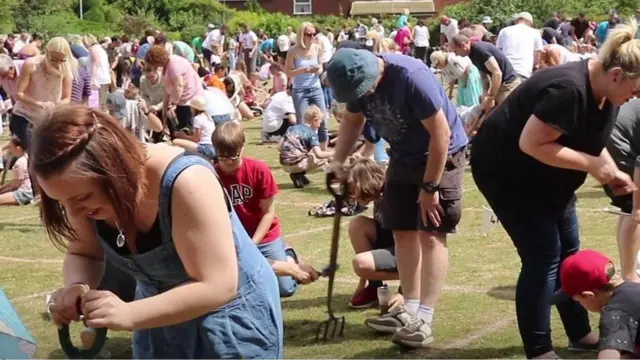
People at a previous World Worm Charming Championship
The event's been held annually since 1980 in the village of Willaston, near Nantwich, Cheshire. , external
Usually competitors each take a 3x3m plot of land and try to lure the worms above ground using only vibrations.
But, due to social distancing restrictions, competitors will instead take part on Saturday afternoon from their own gardens via the video conferencing platform Zoom., external
Dozens have signed up, including from homes in Preston, Croydon and Sheffield, and they will have 30 minutes from 14:00 BST to charm as many worms before counting them afterwards to find the winner.
Residents have described the "mayhem" as tens of thousands of sun-worshippers descended on Bournemouth beach "with no idea of social distancing".
Bournemouth, Christchurch and Poole Council declared a major incident after services were "completely overstretched" as huge numbers of visitors crowded on to the beach on Thursday.
 Image source, PA Media
Pat Munday, 73, described how cars were double-parking and blocking driveways, preventing emergency vehicles from getting through, while people were using the gardens of her apartment block as a toilet on Wednesday and Thursday.
"It was just mayhem, people just want to have a good time but they just don't give a monkey's about others," she said. "It's a shame, it's such a beautiful part of the country but people just need some control, people have lost all sense of respect - when they urinate in your garden, it's the pits."
Vic Williams, 75, said: "There was no idea of social distancing, when we left at 14:00 the crowds were still arriving, there wasn't any two metres...because the restaurants are closed, there's nowhere else for people to go."
He added: "The litter afterwards was unbelievable, they just walk away from the beach and leave their rubbish. There were tents left, BBQs - it costs us ratepayers a fortune."
 Rob England
BBC News
Police chiefs have said people must take "more personal responsibility" when Covid-19 lockdown measures are further eased on 4 July as fines for breaches dropped to their lowest level.
 Image source, PA Media
Tickets handed out in the two weeks to 22 June fell to just 189 from a high of 5,280 in the fortnight to 27 April, according to provisional data, external released by the National Police Chiefs' Council (NPCC) on Friday.
A total of 18,439 fixed penalty notices, including 15,856 in England and 2,583 in Wales, were recorded by forces up to 22 June, according to the provisional data.
NPCC chairman Martin Hewitt said: "As restrictions ease further from July 4 in England, it is important for everyone to take more personal responsibility for their safety by continuing to follow official advice and government regulations.
"Limiting the spread of the virus should still be everyone's priority...I would like to again thank the vast majority of people for abiding by the lockdown measures and government advice."
Kate Scotter and Laura Devlin
BBC News

After the hottest day of the year saw thousands of people descend on beaches around the UK, the BBC went to Great Yarmouth to see the scale of the mess left behind.
The refuse collector's cart is overflowing. There's the usual drinks cans and plastic bottles, but also a crumpled hat, a paperback book and, balanced on top, a wind break.
"It's as if people have gone slightly mad with lockdown easing," says Penny Carpenter, as she helps pick up rubbish along Great Yarmouth beach.
"The word 'unprecedented' is used a lot at the moment, but it is an unprecedented amount of rubbish our teams are picking up."
Ms Carpenter said in the 16 years she has lived in the coastal town, she has never seen anything like the amount of litter left in recent days.
