Goodbyepublished at 17:00 BST 2 July 2020
 Jennifer Meierhans
BBC News
Thank you for joining us for updates on coronavirus across England.
We will be back at 09:00 tomorrow with the latest news stories and information.
Have a good evening.
Updates on Thursday 2 July
Leicester schoolchildren kept at home in local lockdown
Year groups kept isolated in back-to-school plan
UK travel quarantine rules 'not worth it'
Suicide fears soar in LGBT community
'No obvious source' of Leicester Covid-19 outbreak
Jennifer Meierhans
BBC News
Thank you for joining us for updates on coronavirus across England.
We will be back at 09:00 tomorrow with the latest news stories and information.
Have a good evening.
Anyone travelling by bus, train, ferry or plane in England should wear a face covering, external to help reduce the risk of coronavirus transmission.
The rules were introduced, external to coincide with a further easing of lockdown - including the return to class of some secondary school pupils and the reopening of non-essential shops - which was expected to increase the number of people using public transport. Here are the rules.
 Image source, Alamy
Nearly all children of legal school age will be expected to return to class full-time in September - including those with special educational needs and disabilities.
The government says it wants to "start to reverse the enormous costs of missed education".
Attendance will be mandatory again from the beginning of the autumn term.
 Image source, Getty Images
If a school has a suspected coronavirus outbreak - with two or more confirmed cases within 14 days, or an overall rise in suspected coronavirus sickness absence - teachers will work with local health protection teams.
A mobile testing unit may be dispatched - focusing first on those in the affected child or teacher's class, followed by their year group, and then the whole school if necessary.
With social distancing guidance in England changing to "one metre plus" from 4 July, how can you invite friends and family into your home safely?
Who will I be able to have in my own home?
 Image source, Getty Images
Many people won't have seen family or friends for weeks but Prof Alison Sinclair, from the University of Sussex, offers words of caution.
"The hardest but most important thing to do is to postpone the visit if anyone in either household has any Covid-19 symptoms."
The government has announced a further £500m to help councils in England facing extra cost pressures as a result of the coronavirus pandemic.
The money - which can be spent as authorities see fit - comes on top of £3.2bn already received.

Councils have warned of a funding black hole of up to £7.4bn due to increased costs, including social care, coupled with lost income from fees and charges.
Labour urged ministers not to make further cuts to local services.
BBC Match of the Day presenter and ex-England captain Gary Lineker is one of a number of sports stars calling for a big thank you to key workers on Sunday 5 July at 17:00 BST as the NHS marks its 72nd birthday.
Sports stars calling for big thank you to key workers on Sunday.
Various sporting governing bodies are encouraging the nation to come together for one final round of applause for staff who have been working on the front line during the coronavirus pandemic.
Speaking to Rachel Burden on BBC Radio 5 Live Breakfast, Lineker said: “We owe so much to so many people that have gone beyond the line in this period.”
As Leicester becomes the first city to be subject to a local lockdown, misleading claims are being shared across social media.
A number of local councils have come out on Twitter and Facebook to counter online rumours of imminent lockdowns in their areas - making it clear none have been announced.
 Image source, Reuters
A rise in cases has been recorded in some local authority areas but a Public Health England (PHE) spokesperson told the BBC: "To use this data in isolation to predict which areas will see significant increases in cases is not appropriate as it does not provide a complete picture of what is happening locally."
Experts at PHE are currently looking at outbreaks in much smaller areas, rather than whole towns or cities, to inform decisions about any future local lockdowns.
We've identified posts in Facebook groups that may have led to some of the rumours.
Coronavirus: Mandatory attendance for all pupils from September - Williamson
Education Secretary Gavin Williamson addresses the newly released safety plans for the return to school.
Many people in England are still waiting longer than 24 hours for their coronavirus test results, figures show.
Four in 10 tests done by mobile units and three in 10 carried out at regional drive-thru centres were taking longer than that, data up to 24 June shows.
 Image source, MOD / PA
Prime Minister Boris Johnson said he expected such tests to be processed in 24 hours by the end of June.
But the data - the first released on 24-hour turn-around times - shows significant progress has been made.
"Every time my phone rings, I still think it's her," says Sarah Bredin-Kemp.
Three months ago her friend Rebecca Mack died with suspected coronavirus, aged just 29.
Since then Sarah's had to mourn Rebecca in lockdown.
"It's a really, really bizarre feeling of being a bit lost, maybe emotionally stuck," Sarah, who's 27, tells Radio 1 Newsbeat.
Many young people don't like talking about grief but the pandemic means thousands now have to, here are some of their stories.
 Image source, Sarah Bredin-Kemp
Sarah (l), Rebecca (centre) and Alice used to meet for coffee every week
The government has published its safety plans for the return to school in September - built on the principle of keeping classes or whole year groups apart in separate "bubbles".
But it means if there are two confirmed coronavirus cases in 14 days, all the pupils in that group, or even the whole school, may have to be sent home.
 Image source, PA Media
Primary pupils began to return in June but so far it has been a voluntary choice for parents
Schools will have testing kits to give to parents if children show symptoms.
Mobile testing units will be sent to schools that have an outbreak.
Leicester has become the first place in the UK to be put under a local coronavirus lockdown.
Attention has mostly been focused on the city itself, but what of the suburbs on its fringes?

Scott Drake thinks people will just "go down the road" to avoid lockdown
Oadby, a town to the south east of Leicester, has come into closer proximity with the city due to the steady expansion of both and is included in the lockdown area.
Do Oadby's residents feel this is justified? Are they optimistic about the future? Do they feel part of the city or look to the county?
Circles designed to help shoppers and sunbathers in Newcastle city centre stay socially distanced have been worn or washed away after less than a month.
They were painted on popular patches of grass, including Old Eldon Square and around St Thomas' Church, to help people stay 2m apart.

It was done in advance of the city becoming busier as shops reopened and people came out to enjoy the sunny weather.
The city council has said it will be repainting them.
 Daniel Wainwright
BBC England Data Unit
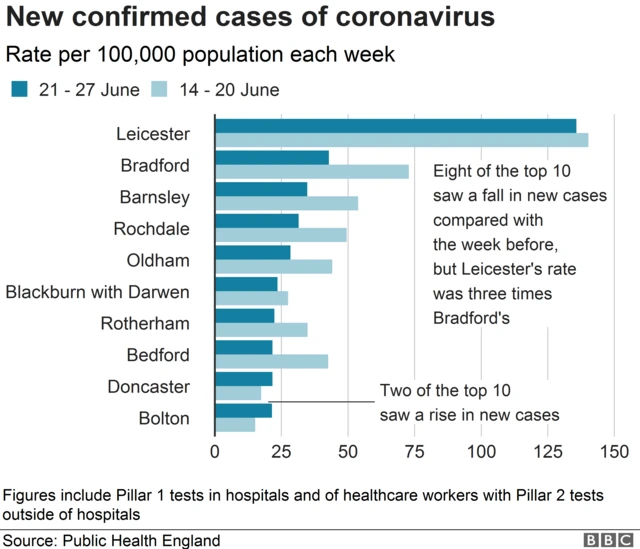
After Leicester, parts of Yorkshire and the north-west of England have recorded the highest rates of new coronavirus infections, according to new data.
However, all but two of the top 10 areas for rates of infection in the week ending 28 June saw a fall compared with the week before, Public Health England reported.
Bedford, the only top 10 place other than Leicester not in the north, has seen its rate of new cases fall by half in a week.
The new data combines two sets of coronavirus tests - those done in hospitals and involving care workers and previously unpublished local figures on tests outside of hospitals.
From 4 July in England, multi-screen cinemas will stagger film start and end times, to avoid congestion in foyers.
There will be hand-sanitising stations and - don't tell the kids - pick 'n' mix stands will be removed.
Film-lovers will also find a number of empty seats or rows between themselves and other groups, depending on the size of the cinema.

Admit One, which provides ticketing services for cinemas and multiplexes, says it can automatically enable socially distanced seating, creating "bubbles" of empty seats around groups when they book.
And some cinemas may not let customers choose where they sit, as this could affect their ability to reach maximum capacity.
The average seat in cinemas is about 60cm (2ft) wide and 97cm deep, Admit One says.
So to meet 2m distancing rules, cinemas would have had to block out 12 seats around a single cinemagoer, or 16 around a couple.
Find out more about what social distancing in cinemas, bars and restaurants will look like.
School pupils in Leicester are being kept at home once again, after the city was made subject to the UK's first local lockdown.
Health Secretary Matt Hancock has ordered schools in the city to close to all but a small number of pupils following a surge in coronavirus cases.

Magda Raszowska said it was "like going back to March"
He said although children were at low risk of serious harm from Covid-19, they can spread the infection.
Schools had been allowed to welcome back some year groups from 1 June.
The tighter restrictions are also affecting schools outside the lockdown area, with pupils told to stay away if they live within the affected area.
 Ben Hunte
BBC London
There has been a significant rise during lockdown in the UK in the number of LGBT people seeking suicide-prevention support.
Support group LGBT Hero reports 11,000 people have accessed its suicide-prevention web pages - up over 44% on the first three months of the year.
 Image source, Science Photo Library
And other LGBT charities have service users who have killed themselves.
The government considers LGBT people to be at higher risk of suicide but no national data on LGBT suicides is kept. Read the full story.
Branwen Jeffreys
Education Editor
I've been answering your questions on what going back to school will look like.
Allow X content?
This article contains content provided by X. We ask for your permission before anything is loaded, as they may be using cookies and other technologies. You may want to read X’s cookie policy, external and privacy policy, external before accepting. To view this content choose ‘accept and continue’.
The UK's first local lockdown has been introduced in Leicester, following a spike in coronavirus cases.
How will they be enforced and how could they be used elsewhere?
 Image source, Getty Images
Residents will have to stay at home as much as they can, while people in other parts of England will have more freedom.
Home schooling is causing stress in millions of homes across the UK. BBC newsreader Kate Silverton, who is also a trainee child psychotherapist and a mother-of-two, has like most parents found lockdown a very challenging time.
"Home schooling may have been a success for some but in my overall experience - and that of the parents I have spoken to - those successes have been few and far between," she writes.
"Whether at the school gates, or in the counselling arena, mums and dads tell me they cannot cope. I would go so far to say that anyone who thinks working and schooling young children from home has been a success is sadly ill-informed."
 Image source, Mike Heron
"My husband and I have tried to make the memories of this time more joyful and positive. So we camped in our (courtyard) garden and have had more late nights, cuddled up watching movies than we would have done previously. However, it has inevitably been a very demanding time for everyone.
"When people ask how I am doing, I often joke that I am "surviving not thriving". When the work calls start, it is very hard to be there for our children." Read the full story.
