Summary

  • Former US Secretary of State Henry Kissinger has died aged 100 at his home in Connecticut, no cause of death has been given

  • Kissinger served as America's top diplomat and national security adviser during the Nixon and Ford administrations

  • He energetically pursued the policy of détente which thawed relations with the Soviet Union and China

  • Critics accused him of war crimes - he oversaw the secret US bombing of Cambodia during the Vietnam War, which killed huge numbers of civilians

  • Kissinger was a joint recipient of the Nobel Peace Prize - along with the leader of North Vietnam - in 1973

  1. Henry Kissinger dies aged 100published at 07:57 GMT 30 November 2023

    Jamie Whitehead
    Live reporter

    We are now bringing our continuing coverage to a close, but there is still more to read if you want further analysis and reaction.

    • For Kissinger's life and career, click here
    • Our news story on Kissinger's death is here
    • And you can watch Kissinger talking about his life and legacy here

    Thank you for joining us.
  2. Kissinger revised his position on Nato and Ukrainepublished at 07:55 GMT 30 November 2023

    Before the Russian invasion of Ukraine in February 2022, Henry Kissinger said that he was opposed to Kyiv joining Nato, saying that such a move would be "not wise" and might lead to escalation.

    A few months after the war began, Kissinger again sparked outcry by suggesting that Ukraine give up territory to Russia to bring an end to the war.

    But his assessment of the war changed over time.

    Speaking at the World Economic Forum via video link last January, Kissinger said: “Before this war I was opposed to the membership of Ukraine in Nato, because I feared it would start exactly the process we are seeing now."

    But now, “the idea of a neutral Ukraine in these conditions is no longer meaningful," he added

  3. Japanese PM praises Kissinger's contributions to 'peace and stability' in Asiapublished at 07:49 GMT 30 November 2023

    Japanese prime minister Fumio Kishida has praised Kissinger's "significant contributions" to "peace and stability" in Asia.

    "I'd like to express my most sincere respect to the great achievements he made," Kishida said, while offering his condolences.

  4. Divisive diplomat who shaped world affairspublished at 07:38 GMT 30 November 2023

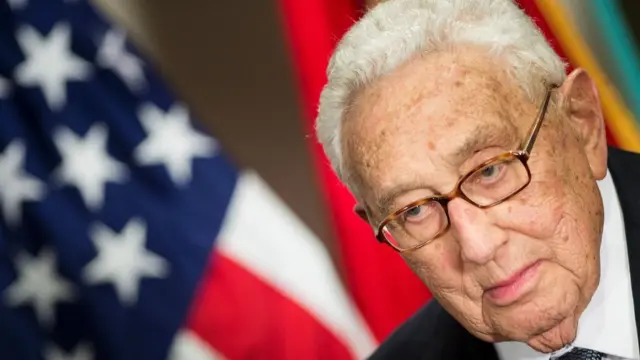
    Henry Kissinger in front of US flagImage source, Getty Images

    Henry Kissinger divided opinion.

    A committed practitioner of "realism" in foreign relations, he was both awarded the Nobel Peace Prize and roundly condemned as a war criminal.

    As US National Security Adviser and Secretary of State, he energetically pursued the policy of détente - which thawed relations with the Soviet Union and China.

    His shuttle diplomacy helped end the 1973 Arab-Israeli conflict; and the negotiation of the Paris Peace Accords pulled America out of its long nightmare in Vietnam.

    But what his supporters described as "Realpolitik", his critics condemned as immoral.

    Read more on Kissinger's life here.

  5. Pioneer of shuttle diplomacypublished at 07:24 GMT 30 November 2023

    James Landale
    Diplomatic correspondent

    Henry KissingerImage source, Getty Images

    Henry Kissinger was one of the Cold War’s most influential statesmen.

    As a child he fled Nazi Germany with his Jewish family, but he returned to Europe to fight with the US Army.

    As a young scholar he argued nuclear weapons could be used in conventional wars.

    He entered government with President Nixon, first as national security advisor, then secretary of state.

    His big idea was to try and avoid global conflict by balancing competing powers, so he led America’s re-engagement with communist China and sought a detente with the Soviet Union through arms control.

    His tireless efforts to find peace in the Middle East coined the phrase “shuttle diplomacy”. He became something of a celebrity.

    But his handling of the Vietnam War - especially the bombing of Cambodia, which killed hundreds of thousands - led some to accuse him of being a war criminal.

    In later life he engaged in lucrative consultancy, his counsel valued as much in the Oval office as in the commercial boardroom.

  6. Years later, Kissinger was still well liked by Chinapublished at 06:59 GMT 30 November 2023

    Anthony Zurcher
    North America correspondent

    Henry Kissinger may have last held a position in the US government in 1977, but he still loomed large in the eyes of Chinese officials.

    On Antony Blinken’s trip to Beijing this June - a high-stakes encounter that was the US secretary of state’s first since the January spy balloon incident - the Chinese welcomed the American diplomat to the same lush estate that Henry Kissinger visited in his groundbreaking 1971 trip to China as Richard Nixon’s national security advisor.

    Over a dinner meeting with then-foreign minister Qin Gang, the Chinese made a point of noting that they were serving Blinken the same fried prawn dish that Kissinger had particularly enjoyed during his trip there 52 years earlier.

  7. A 'partnership that produced peace' - Nixon's daughterspublished at 06:28 GMT 30 November 2023

    Richard Nixon and Henry KissingerImage source, Reuters

    Richard Nixon's daughters described Henry Kissinger "as one of America's most skilled diplomats" who "stood by our father's military decisions" to end the Vietnam War.

    In a statement, Tricia Nixon and Julie Nixon Eisenhower cited his work during their father's presidency, including his role in the Paris negotiations which helped bring an end to US involvement in Vietnam and improving ties with China and the Soviet Union.

    They described the Nixon-Kissinger relationship as a "partnership that produced a generation of peace for our nation".

    The statement continues: "Henry Kissinger will be long remembered for his many achievements in advancing the cause of peace. But it was his character that we will never forget."

  8. Kissinger makes US headlines one more timepublished at 05:59 GMT 30 November 2023

    Brandon Drenon
    Reporting from Washington DC

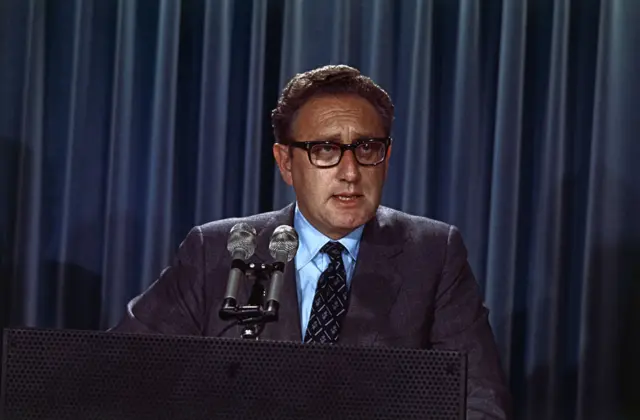
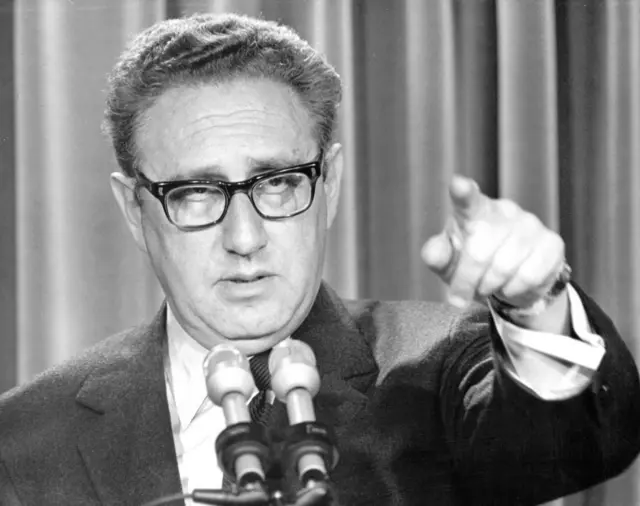
    Henry Kissinger speaks at a press conferenceImage source, Getty Images

    US media headlines reflect Kissinger's polarising life in politics.

    • Rolling Stone: Henry Kissinger, War Criminal Beloved by America’s Ruling Class, Finally Dies
    • CNN: Henry Kissinger, a dominating and polarizing force in US foreign policy, dies at 100
    • The Intercept: Henry Kissinger, Diplomat Responsible for Millions of Deaths, Dies at 100
    • Washington Post: Henry Kissinger, who shaped world affairs under two presidents, dies at 100
    • CNBC: Henry Kissinger, the towering American diplomat, dies at age 100

  9. Chatting to Putin in Germanpublished at 05:37 GMT 30 November 2023

    Sean Seddon
    Journalist

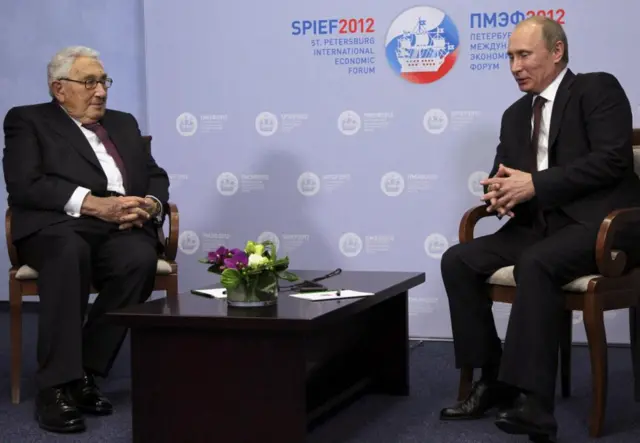
    Henry Kissinger and Vladimir Putin on stage togetherImage source, Reuters

    In a June 2022 interview with BBC Radio 4, Henry Kissinger reflected on his extraordinary career.

    He described meeting Vladimir Putin in the mid-1990s when the future Russian president was still little known outside St Petersburg, the city where he cut his teeth politically.

    Kissinger recalled how the pair had chatted in German and said young Putin had struck him as "intelligent, driven by a kind of mystic view of Russia", before reflecting on the implications of the war in Ukraine.

    You can hear that full interview on BBC Sounds here.

  10. Kissinger on camera through the yearspublished at 04:56 GMT 30 November 2023

    We've been looking back through the archive at key moments in Henry Kissinger's career. You can watch some of them below in a package edited by Nicole Ng.

    Media caption,

    Watch: Henry Kissinger’s life and legacy in his own words

  11. 'He stretched my patience but also my horizons' - former aide on Kissingerpublished at 04:45 GMT 30 November 2023

    Sean Seddon
    Journalist

    Henry Kissinger in the White HouseImage source, Reuters

    Winston Lord, who served as a special assistant to Henry Kissinger while he was working in the White House as National Security Advisor, said America had "lost a tireless champion for its national interest".

    Lord - who went on to be the US ambassador to China - told the BBC News channel what it was like to work closely with the man at the centre of American foreign policy.

    He said: "He was my mentor but I also used to joke he was my tormentor because he was extremely demanding, he stretched my nerves and my patience, but he also stretched my abilities, my capabilities and my horizons.

    "So, I'm always grateful to him, not only for the success I was able to share in with him, but also what he taught me for the rest of my life in terms of strategic analysis and working in the fields of diplomacy."

  12. Chinese envoy pays tributepublished at 04:28 GMT 30 November 2023

    In a post, external on X, Chinese ambassador to the US Xie Feng said he was "deeply shocked and saddened" to learn about the death of Kissinger.

    "It is a tremendous loss for both our countries and the world," he said."The history will remember what the centenarian had contributed to China-US relations, and he will always remain alive in the hearts of the Chinese people as a most valued old friend," he added.

  13. A life in picturespublished at 04:27 GMT 30 November 2023

    Sam Hancock
    Live reporter

    Born in 1923, Henry Kissinger's life spanned generations - and his career spanned leaders, serving under US Presidents Nixon and Ford.

    Here's a look at some of his life in pictures.

    US President Richard Nixon and National Security Advisor Henry Kissinger stand at an Oval Office windowImage source, Reuters
    Image caption,

    1971: Kissinger with Nixon at an Oval Office window in the White House

    Kissinger watches on as President Nixon meets Israeli Prime Minister Golda MeirImage source, Reuters
    Image caption,

    1973: Kissinger (right) watches on as President Nixon meets Israeli Prime Minister Golda Meir

    Henry Kissinger points to a map of the Sinai during a meeting with US President Gerald Ford in the Cabinet Room at the White HouseImage source, Reuters
    Image caption,

    1977: Kissinger points to a map of the Sinai at a meeting of President Ford (second from right)'s cabinet

    Diana, Princess of Wales sits next to Henry Kissinger at an awards ceremony in 1995Image source, PA Media
    Image caption,

    1995: Kissinger shares a laugh with Diana, Princess of Wales, at an awards ceremony in New York

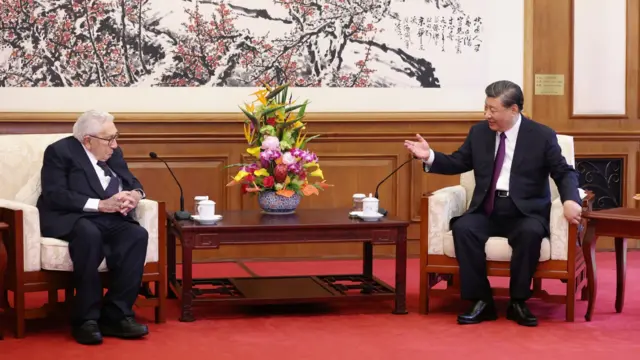
    Chinese President Xi Jinping and Henry Kissinger, former US secretary of state, sit for a meeting in Beijing in July 2023Image source, Reuters
    Image caption,

    2023: Being 100 did not stop Kissinger from getting involved again - seen here with Chinese President Xi Jinping earlier this year

  14. More than 100 trips to Chinapublished at 04:10 GMT 30 November 2023

    Fan Wang
    BBC News, Singapore

    U.S. President Gerald Ford and his daughter Susan watch as U.S. Secretary of State Henry Kissinger shakes hands with Mao Zedong, Chairman of Chinese Communist Party, during a visit to the Chairman's residence in Beijing, China, December 2, 1975.Image source, Reuters
    Image caption,

    US President Gerald Ford (centre) watches on as Mao Zedong and Kissinger shake hands during a 1975 visit to Beijing

    Though Kissinger had a controversial reputation in other parts of Asia for his role in the Vietnam War, in China he was highly regarded for his unique contribution in helping establish diplomatic relations between the country and the US.

    He had visited China more than 100 times, and his most recent trip was in July this year where he was welcomed by President Xi Jinping.

    To this day, Chinese people learn his name in history classes and see him as an “old friend” to them.

    And when the news of his death broke hours ago, it immediately triggered massive reactions among Chinese people.

    State media outlet China News described him as someone who had “a sharp vision and could see through the world's affairs”.

    State broadcaster CCTV called him a “living fossil” who witnessed the development of the bilateral relationship.

    “You are forever a friend of Chinese people, rest in peace,” a top-liked comment on the country’s social media platform Weibo reads.

    “He witnessed decades of ups and downs. What would he think about the current China-US relations?” another user asked.

  15. Analysis

    Hero to some, warmongering villain to otherspublished at 03:55 GMT 30 November 2023

    Anthony Zurcher
    North America correspondent

    No man in the past half-century has had a more profound, lasting impact on US foreign policy than Henry Kissinger.

    That has made him a hero and a trusted counsellor to some and a warmongering villain to others.

    If politics is the art of the possible, Kissinger’s foreign policy was the elevation of the practical. It was a cold-eyed calculation that put power and national benefit above emotions, ideology, doctrine and, some would say, moral principles.

    An adviser to Presidents Richard Nixon and Gerald Ford, Kissinger’s brand of statecraft was capable of historic successes – including normalising US-China relations and using detente to bring some stability to the Cold War with the Soviet Union.

    It also paved the way for human rights abuses of breathtaking scope, such as indiscriminate bombing in Southeast Asia, the destabilisation of democratically elected socialist leaders and support for ruthless pro-American dictators across the globe.

    In a 1955 essay, Kissinger wrote an article describing “grey areas” of the world that exist beyond America’s closest allies. Kissinger lived his life in a grey area - where light and dark, war and peace, right and wrong blend into a colourless haze.

    Kissinger and his fellow foreign policy realists would say, like it or not, this is the way the world is. Their critics would counter that this is the world that people like Kissinger created.

  16. From Cambodia to Crimeapublished at 03:31 GMT 30 November 2023

    Henry Kissinger poses for a portraitImage source, Getty

    Heinz Alfred Kissinger was born into a middle-class Jewish family in Bavaria on 27 May 1923.

    The family left it late to flee the Nazi persecution, but they joined the German-Jewish community in New York in 1938.

    He was drafted to the military in high school and assigned to the infantry where his brains and language skills were put to use by military intelligence.

    At 23, he was given a team to hunt down former Gestapo officers, with absolute power to arrest and detain suspects.

    In the US, he studied political science at Harvard University.

    He gained popularity with his book Nuclear War and Foreign Policy, published in 1957, which promoted the limited use of atomic missiles.

    With the Cold War at its height, Kissinger became National Security Advisor under President Richard Nixon in 1968.

    Kissinger's policy of détente - French for improved relations - helped to ease tensions between US and China, leading to Nixon's historic trip to China in 1972.

    Later, he negotiated the American military withdrawal from South Vietnam, winning him the Nobel Peace Prize alongside North Vietnam's Le Duc Tho.

    However, his efforts there were controversial, to say the least. He supported Nixon and bombing raids on neutral Cambodia. The policy resulted in the deaths of tens of thousands of civilians.

    His diplomatic savviness helped bring about a ceasefire following the 1973 Arab-Israeli war.

    Kissinger soon became known for his Realpolitik style.

    After the election of the Marxist Salvador Allende, the CIA carried out covert operations in Chile to protect US interests and overthrow the new government. Kissinger chaired the committee that authorised the action.

    And, in later years, Kissinger himself would be pursued by a number of courts investigating human rights abuse and the deaths of foreign nationals under the military regime.

    Always influential, he briefed Donald Trump on foreign affairs after his election in 2017 - suggesting, among other things, acceptance of Vladimir Putin's occupation of Crimea.

    To the fury of many, he remained unapologetic about his single-minded pursuit of US interests, and the defence of his adopted county's way of life.

    "A country that demands moral perfection in its foreign policy," he once declared, "will achieve neither perfection nor security."

  17. 'A great one has passed' - Mitt Romney reactionpublished at 03:18 GMT 30 November 2023

    US Senator and former Republican presidential nominee Mitt Romney paid tribute to Henry Kissinger, saying "a great one has passed".

    In a post on X, formerly Twitter, he said: "Fortunate indeed is America for his lifetime of diplomacy, wisdom, and love of freedom."

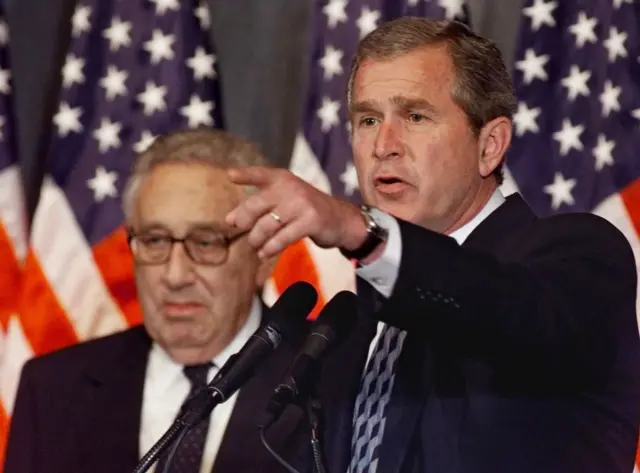
  18. 'Dependable and distinctive voice' - George W Bush pays tributepublished at 03:17 GMT 30 November 2023

    Henry Kissinger and George W BushImage source, Getty Images

    Former President George W Bush has led the tributes to Kissinger.

    In a statement issued via his foundation, he said America has "lost one of the most dependable and distinctive voices on foreign affairs".

    It continued: "I have long admired the man who fled the Nazis as a young boy from a Jewish family, then fought them in the United States Army.

    "When he later became Secretary of State, his appointment as a former refugee said as much about his greatness as it did America’s greatness.

    "He worked in the Administrations of two Presidents and counselled many more. I am grateful for that service and advice, but I am most grateful for his friendship."

    Bush said he and his wife would miss Kissinger's wisdom, charm and humour.

  19. Moral convictions plus what is possible - Kissinger's approachpublished at 03:06 GMT 30 November 2023

    In 1973, Kissinger won the Nobel Peace Prize for his efforts to end the Vietnam War but his record, including the US bombing of Cambodia which killed hundreds of thousands, led some to accuse him of being a war criminal.

    He once described the realities of conducting foreign policy like this: "In many individual cases you have to combine your moral convictions with what it is possible to do within a given framework.

    "So for outsiders it is fairly simple to make declarations. The policy maker has to get from here to there and if he cannot do that, then no rhetoric will do him any good."

  20. An extraordinary lifepublished at 03:06 GMT 30 November 2023

    Henry Kissinger and Richard NixonImage source, Reuters
    Image caption,

    Kissinger (left) was brought into the White House by Richard Nixon

    Henry Kissinger was 15 years old when he and his family fled Nazi Germany and moved to New York in 1938.

    After serving in the US Army and becoming a respected academic, Kissinger entered the White House as President Richard Nixon's right hand man on foreign policy in 1969.

    In 1973, he was also appointed to the role of secretary of state, giving him unprecedented influence over how the US conducted itself around the world during the Cold War.

    Kissinger played a key role on US relations with Soviet Russia and China. He will also be remembered for his influence over the Vietnam War.

    He continued to be a vocal contributor on international matters into old age, even meeting with Chinese President Xi Jinping in July aged 100.

    Read the full story on his death here.