Cambridge professor lifts world tiddlywinks crown

 PA Media
A professor at the University of Cambridge has flicked the competition aside in a high-stakes game of tiddlywinks to retain his coveted world title.
Tiddlywinks is a game in which players try to get small plastic discs into a cup by pressing one piece against another to make it fly through the air.
It can be traced back to Victorian times, but the birth of the modern game stems from a group of Cambridge undergraduates meeting in Christ's College in 1955, the English Tiddlywinks Association said.
Prof Patrick Barrie, 61, won the World Singles Tiddlywinks Championships on Thursday, beating Dave Lockwood of the US in a seven-hour match held at the Castle Inn pub in Cambridge.
Barrie, of the university's Department of Chemical Engineering and Biotechnology, likened the fixture to "a boxing world title" in its challenger format.
"You have a champion and only a national singles winner can challenge you," he said.
 PA Media
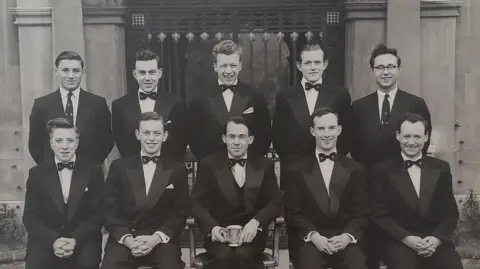 University of Cambridge
American tiddlywinks veteran Dave Lockwood lives just outside Washington DC and is known in flicking circles as "the Dragon".
Barrie said of his 26-23 victory: "It's a curious mixture of elation and relief. I'm very pleased."
He admitted "it was a long old match; it went on for seven hours; it was close, hard-fought".
"The relief is because I was favourite to win and expected to win, which puts you under a different type of pressure," he said.
 PA Media
Tiddlywinks is popular with children and on the surface seems very simple, but Barrie insisted the game was "a nice mixture of physical skill, but with some intellectual thinking".
"You've got to think about strategy and tactics; you have to control your nerves," he said.
"Knowing when to play the shots is what takes quite a lot of years to develop.
"When I was young, I took up lots and lots of hobbies and I little thought the only one I would still be doing decades later would be playing tiddlywinks, and competitively."
 PA Media
The championship match umpire, Harley Jones, chairman of the English Tiddlywinks Association, said the game was "like chess, if you could miss" and Thursday's game was "really nail-biting".
He said there were just two national singles championships, the English and the American, and there were "about 120 people in the world ratings which is the number of people who've played in a tournament in the last year".
Triumphant Barrie described Lockwood as "a formidable opponent", adding: "I had to do my best to make sure it wasn't his day."
Do you have a story suggestion for Cambridgeshire? Contact us below.
Follow Cambridgeshire news on BBC Sounds, Facebook, Instagram and X.
