The Ferguson ships that nobody talks about

 BBC
Mention the Ferguson shipyard and two ships usually spring to mind.
Glen Sannox and Glen Rosa, the overbudget and long overdue CalMac ferries, have understandably attracted plenty of attention.
But the small Inverclyde shipyard at the centre of Scotland's ferries saga has a much longer story, one which is seldom told.
It was in January 1903 that the four Ferguson brothers - Peter, Daniel, Louis and Robert - leased the derelict Newark yard, surprisingly located next door to a 15th Century castle, in Port Glasgow.
The site itself was no stranger to shipbuilding - the first recorded launch there took place in 1790 - and neither were the Ferguson brothers who had worked at their father's business, Fleming & Ferguson, in Paisley.
 Michael Conway
Ten months later the first Ferguson Brothers vessel, Flying Swift, left the building berth - a steel-hulled tug built for the Clyde Shipping Company.
The occasion was celebrated with a "wine and cake banquet" according to the Greenock Telegraph which recently reprinted extracts from its original 1903 report.
By December - the same month the Wright Brothers made their famous 12-second flight in their new-fangled flying machine - Flying Swift was finished, and work was well-advanced on a second tug.
That first boat outlived the Ferguson family's connection with the yard which ended in 1954 with the death of Bobby Ferguson, son of one of founding brothers Robert. Flying Swift finally went to the breakers in 1957.
But for longevity it is surpassed by another Ferguson vessel.
 Tug Lyttelton Preservation Society
 Tug Lyttelton Preservation Society
The steam tug Canterbury, built in 1907 for £14,126 and 10 shillings, was soon making a 69-day journey via the Suez Canal to Lyttelton, New Zealand, to serve as the port's tug, pilot boat and fireboat. On arrival it was declared "the finest tug in the colony".
Its first high profile job came on New Year's Day 1908 when it escorted Sir Ernest Shackleton's ship Nimrod out of the harbour at the start of the Antarctic expedition that made him a national hero in Britain.
Soon renamed after the town it served, the tug is still there, lovingly cared for by the volunteers of the Tug Lyttelton Preservation Society.
Those first Ferguson vessels were all tugs, dredgers or barges but in 1908 the yard built its first ferry.
 Ferguson Marine
 Ferguson Marine
Vehicular Ferryboat No. 3 (as it was unimaginatively named by the Clyde Navigation Trust) became better known to Glaswegians as the Finnieston "horse ferry" because of the horse-drawn carts it carried across the river near where the Finnieston crane stands today.
The strange-looking vessel had a deck that could be raised or lowered by winches to the level of the quays depending on the height of the tide.
A second of these horse ferries, Vehicular Ferryboat No. 4, was built for the Govan crossing in 1938. They were still ferrying vehicles across the river into the mid-1960s when the new Clyde Tunnel made them redundant.
As World War One engulfed Europe, demand for ships swelled the order book. The yard was building hospital ships and minesweepers in 1917 when King George V became the first of many royal visitors over the years.
 Michael Conway
His visit to Ferguson's and the Colville steelworks in Motherwell was reportedly part of a plan to bolster patriotic feelings among Clydesiders amid concern about growing Communist sympathies.
While the larger shipyards up river like John Brown's or Fairfield's were building giant liners and warships, the Ferguson yard carved out a solid reputation for smaller specialist vessels.
The most illustrious was RRS Discovery II, completed in 1929 for the Discovery Committee of the Colonial Office to research whales and their habitats in Antarctica.
 National Oceanographic Library
 Michael Conway
Named after Robert Falcon Scott's famous wooden ship that is now a visitor attraction in Dundee, it was equipped with laboratories and built from steel, cross-braced with timber, to withstand the ice floes it would encounter.
In January 1932 its strength was tested when it was caught in heavy pack ice in the Weddell Sea, not far from the spot where Shackleton's ship Endurance was crushed and sank 16 years earlier.
At one point the rivets started breaking, making a sound like a machine gun, but Discovery II escaped with a few leaks and a twisted rudder stock.
Later that year the ship became the first vessel to circumnavigate Antarctica in winter.
 Google Earth
The crew had already shown their appreciation of the shipyard when they surveyed a small inlet on Thule Island in 1931 and named it Ferguson Bay.
The east and west edges of the bay were named Hewison Point and Herd Point, after the shipyard's manager and company secretary.
When in late 1935 the American polar explorer Lincoln Ellsworth and his British pilot Herbert Hollick-Kenyon went missing while trying to fly across Antarctica, Discovery II was sent to search for them.
The story ended happily - the pair had run out of fuel and ditched their plane but a broken radio meant they spent weeks sheltering at a deserted exploration hut before the crew found them in January the following year.

Finally broken up after 33 years of service, the research ship has been celebrated on two postage stamps (in the Falkland Islands and Australia) and had a book written about its adventures.
Most people waiting at the bus stop outside the old Port Glasgow Town Hall building are probably puzzled by a series of curves marked out in the pavement. They are the hull lines of Discovery II - from the architect's drawings for what was until recently the most famous Ferguson ship.
World War Two was a busy time for the small Port Glasgow shipyard, building no fewer than 32 vessels for the Ministry of Transport or the Admiralty, including nine small warships to protect the convoys.
 Imperial War Museum
 Glasgow City Council
In September 1940 when the heavy cruiser HMS Sussex was hit by a 250lb German bomb while undergoing repairs at Yorkhill Quay, the Ferguson-built Ferryboat No.4 helped put out the flames.
The majority of vessels that have left the Ferguson slipway have had more mundane duties - but every ship has a story.
Sludge boats were designed to take the strain from Britain's overburdened Victorian sewage system. The solid waste was picked up from treatment plants and dumped out at sea. Londoners nicknamed the Thames versions "Bovril boats".
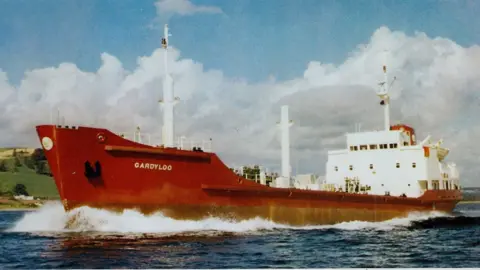
In 1976, Ferguson's built one such vessel for Lothian Regional Council named Gardyloo - after the traditional warning cry given by the Edinburgh residents before they emptied their chamber pots out of tenement windows.
 Ferguson Marine
After a brief spell on the Clyde, the ship took up duties in Edinburgh in 1978, helping to end the practice of pouring the city's waste directly into the Forth.
Despite their filthy cargo, the sludge boats were kept spotlessly clean and often took daytrippers. Gardyloo soon became an unlikely visitor attraction.
The ship's route took it past thriving bird colonies at Bell Rock or St Abbs, making the trips popular with birdwatchers and pensioners, who travelled for free.
Refreshments were available. Guests often enjoyed a coffee and a roll during the seven-hour cruise as the ship gently relieved itself of its toxic cargo. By the time an EU directive abruptly ended sewage dumping at sea in 1998, Gardyloo had carried more than 6,000 passengers.
Finding a new role for a ship with such a pedigree was a challenge - but it was eventually sold to a shipping company in Azerbaijan where it operates as a drinking water carrier, renamed Shollar after a mountain spring.
 Thomas Atkinson
 Iain Erskine
Ferries and Ferguson's are two words that nowadays seem to hang together naturally, but the many successful builds before Glen Sannox and Glen Rosa are rarely mentioned.
West coast ferry operator CalMac has 10 major vessels longer than 80 metres. Half of them were built at Ferguson shipyard.
Among them is the oldest large ship in the fleet, MV Isle of Arran, launched in December 1983 and still serving the route it was named after. It was followed by MV Isle of Mull (1987), MV Lord of the Isles (1989), MV Isle of Lewis (1995) and MV Hebrides (2000).
The late Queen launched Hebrides, her second visit to the Port Glasgow yard in eight years.

Two fisheries research ships MV Scotia (1998) and Cefas Endeavour (2002) showed the yard could still build technologically-advanced ships. They required exceptionally low noise levels so that they could sneak up on the fish shoals. Some joked that they might actually be spy ships.
But by now Ferguson's was the last surviving commercial shipbuilder on the Clyde, struggling to match the prices of overseas competitors, particularly in eastern Europe.
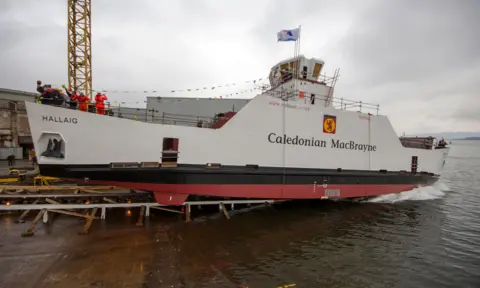
From 2012 onwards it was kept afloat with orders for small CalMac ferries - pioneering diesel/battery-powered hybrids.
 Devlin Photo
 Devlin Photo
Two had been built when the yard went bust in 2014, by which time the workforce had dwindled to just 70. A third was constructed, on time and on budget, after the firm was rescued by businessman Jim McColl.
The story of the latest ships, Glen Sannox and Glen Rosa, is long and complicated, a product of a unique set of circumstances.
Delays and cost over-runs have left the workforce embarrassed by events beyond their control, but many in the local community remain fiercely loyal to the yard.
Ferguson's has no more ship orders beyond those ferries. The shipyard is pinning its hopes on an order for seven small CalMac vessels, similar to the three it delivered successfully before Scotland's ferries saga began.
When Glen Rosa finally enters the Clyde next March, it will be the 363rd vessel launched under the Ferguson name. In Port Glasgow and across Scotland there are many who hope it won't be the last.
