Scotland could see hottest day on record amid heatwave warning

 BBC
Scotland is approaching its hottest day on record with temperatures forecast to hit up to 35C (95F).
Unofficial weather stations have recorded temperatures in excess of 35C, but the highest official temperature reported by the Met Office was 32.3C at Eskdalemuir in Dumfries and Galloway.
The existing Scottish record was set at Greycrook in the Scottish Borders on 9 August 2003.
An amber warning for extreme heat remains in force across until midnight.
The Met Office has also warned of the potential for thunderstorms across parts of south-east Scotland and northern England, between 16:00 and 20:00.
Most of Scotland saw high temperatures on Monday, with Edinburgh and Aberdeenshire passing the 30C mark.
The heatwave continued overnight with a high of 20.5C (68.9F) at Dundrennen, Kirkcudbrightshire. It was close to the Scottish record of 20.9 C (69.6F) registered on 26 July 2019.
 Met Office
Speaking on Monday, Met Office forecaster Mark Wilson said: "Across southern parts of Scotland we could see up to 35C, that's the top end.
"If we see that, it would be an all-time record for Scotland by a couple of degrees so we will be watching closely."
As temperatures rose and the UK set a new record of 40.2C (104.3F) at Heathrow in London, the heat continued to put pressure on transport.
Avanti west coast have cancelled all services for the rest of the day after multiple incidents across the network. The train company advised customers not to come to stations.
Allow X content?
Various agencies issued caution and warned of disruption:
- LNER cancelled all trains south of York, with Avanti West Coast and Transpennine Express running a much reduced service
- ScotRail said staff were working hard to keep everyone moving safely but speed restrictions were in force in some areas
- Agencies including Loch Lomond and the Trossachs National Park urged care around water, emphasising the risk of cold water shock
- The risk rating for wildfires in eastern and southern areas of Scotland was raised to "very high" until Friday 22 July. The Scottish Fire and Rescue Service urged the public to avoid lighting fires outdoors
- The Scottish SPCA advised dog owners to only walk dogs early in the morning or late at night if cool enough
Allow X content?
On Monday the temperature rose to 31.3C (88.3F) in Aboyne in Aberdeenshire, and Leuchars in Fife, the Met Office said.
Elsewhere, the Royal Botanic Garden in Edinburgh recorded 30.8C (87.4F), and the mercury peaked at 29.9C (85.8F) in Aviemore.
A national emergency has been declared in the UK, with an unprecedented red extreme heat warning issued in England.

Justice Secretary and lead minister for resilience Keith Brown said the Scottish government was getting regular updates from transport providers, the NHS and emergency services on the impact of the heatwave.
He said: "I would urge people to think about whether they need to travel and if they do, make sure they're properly equipped, and plan their journey in advance.
"Rail passengers and drivers should make sure they have water, sunscreen, hats and sunglasses and have a fully charged phone in case of any difficulties.
"When temperatures increase, it's important to monitor forecasts and follow public health advice, including staying hydrated and drinking plenty of fluids and avoiding excess alcohol."
 Sandra Whyman
Mr Brown also told BBC Radio's Good Morning Scotland programme that extreme weather events must be used to shape future policy.
For example, he highlighted increased investment by Network Rail to limit the disruption caused by landslides.
Mr Brown said: "We have to use this experience to learn further and accelerate some of the proposals that we already have in place to make sure that we can mitigate the effects in future."
 BBC Weather Watcher/Hadi
NFU Scotland said that harvest time had come about a week early for many farmers due to the heatwave.
But water scarcity could be an issue for the sectors who irrigate - those producing potatoes, vegetables and soft fruit.
NFUS has provided farmers with advice from the Scottish Environment Protection Agency (Sepa) for those who extract water.
 Getty Images
Scottish Water has asked the public to be as efficient as possible with water use, including using watering cans rather than hoses in gardens, not to fill up paddling pools and to take shorter showers.
And the Scottish Environment Protection Agency (Sepa) has advised businesses to reduced their water usage to help current water scarcity issues.

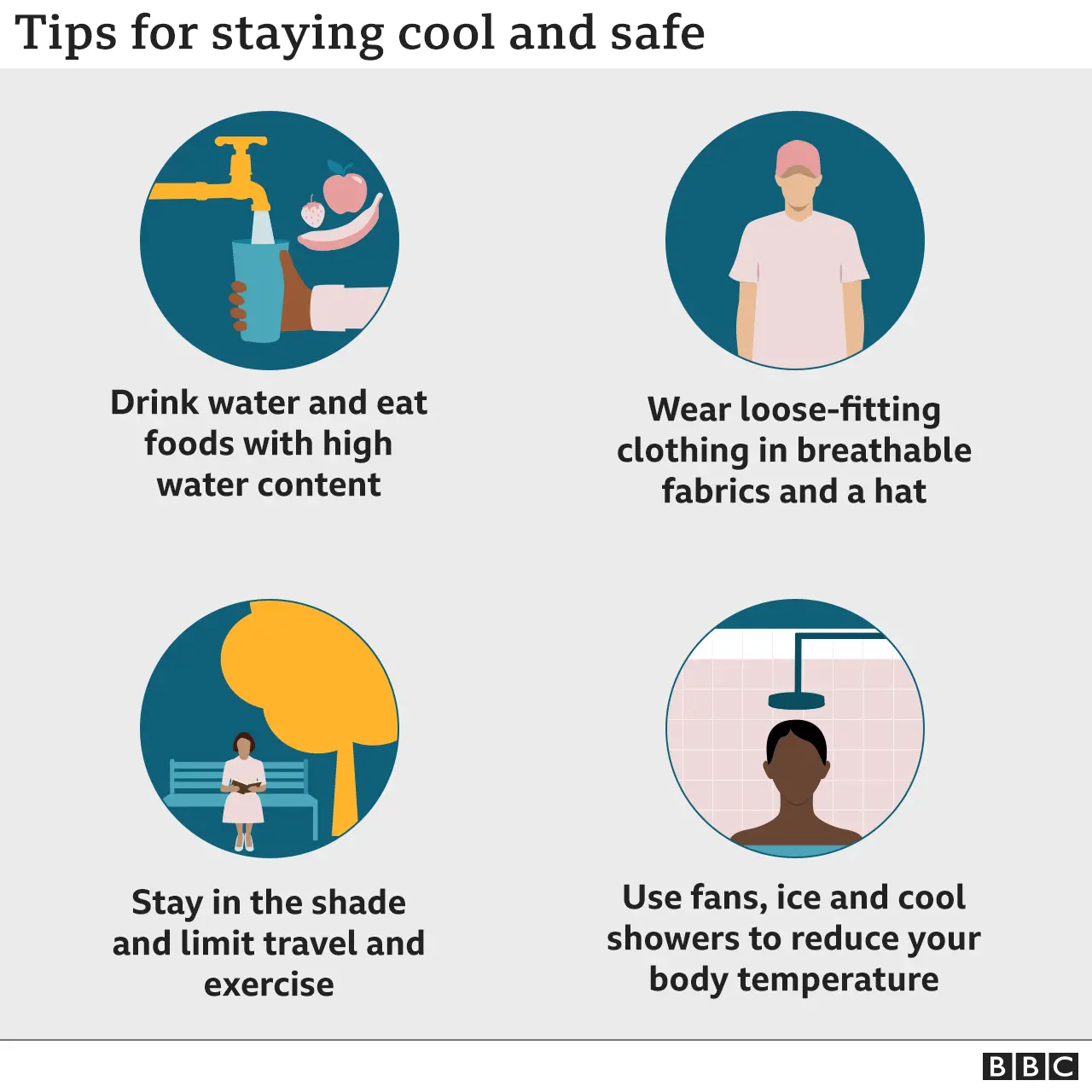
The risk to health of high temperatures has also prompted the release of public health advice including drinking plenty of fluids, keeping out of the sun and avoiding exercise in the hottest part of the day.
Concern is highest for the very young, those with underlying health conditions, and for the elderly.
Events such as Musselburgh Races had first aiders watching over spectators to for any heat-related problems.
Climate change, which has pushed up global temperatures by 1.2C on pre-industrial levels, is making heatwaves longer, more intense and more likely.
Where is the amber heat warning in Scotland?
The weather alert north of the border affects:
- Scottish Borders
- Dumfries and Galloway
- East Lothian
- West Lothian
- Midlothian
- Edinburgh
- Fife
- Dundee
- And parts of Perthshire, Falkirk, Ayrshire, Stirling, Clackmannanshire and Lanarkshire.